
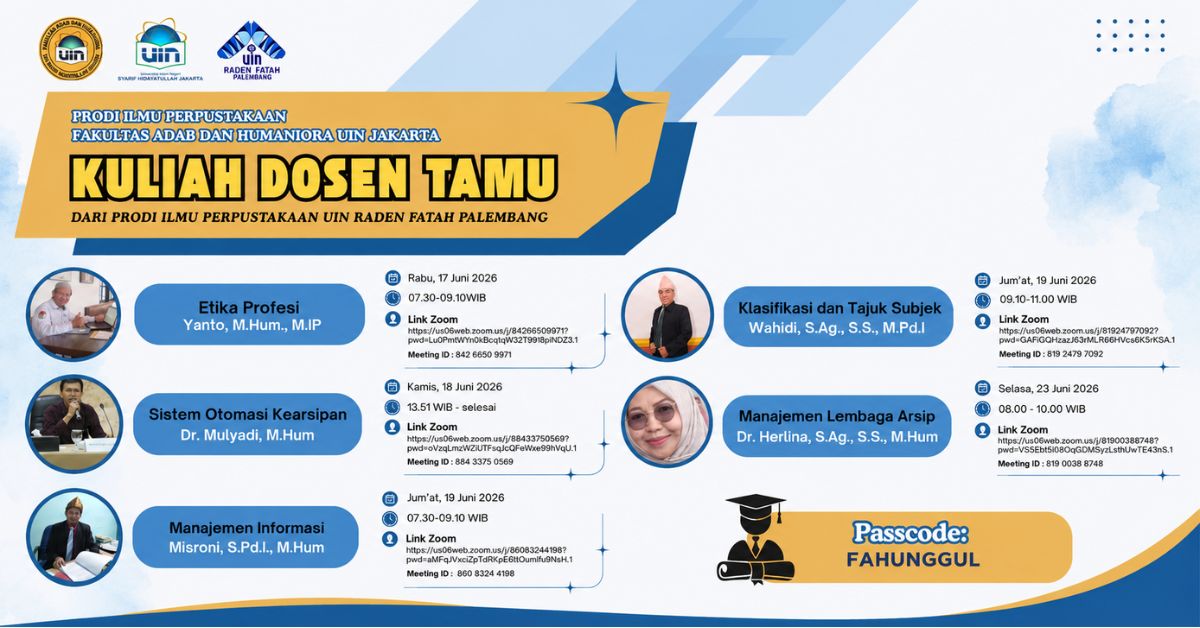
UIN Jakarta’s Library Science Study Program Holds Guest Lecture on the Significance of Professional Ethics for Librarians
South Tangerang, FAH Online News – The Library Science Study Program at the Faculty of Adab and Humanities, Syarif Hidayatullah State Islamic University Jakarta, successfully held a Guest Lecturer Session on Wednesday, June 17, 2026. The academic activity, organized as part of a course taught by Dr. Ida Farida, MLIS, featured Yanto, M.Hum., M.IP., a lecturer from Raden Fatah State Islamic University Palembang, as the main speaker. He delivered an in-depth presentation on the Professional Ethics of Librarians. The session focused on the implementation of the Indonesian Librarians Association’s Code of Ethics in the areas of public service and professional integrity. The presentation began by examining the basic concept of ethics as a critical reflection on moral teachings, as well as the definition of a profession as an occupation that requires specialized expertise and competency standards. Professional ethics are therefore crucial because they serve as the primary guideline for librarians in carrying out their duties and responsibilities professionally.
The implementation of professional ethics in the library field primarily aims to provide clear direction in performing professional duties, preserve the dignity and authority of the profession, and improve the quality of services delivered to the public. Furthermore, these ethical norms ensure the proper functioning of strategic mechanisms, including monitoring the conduct of members of the profession, protecting the rights of the public from potential harm, and preventing and resolving internal conflicts objectively. These functions are supported by strong principles, including full responsibility for work outcomes, fairness in providing services without discrimination, academic freedom, moral integrity, and the protection of clients’ private and confidential data. In practice, a written code of ethics collectively agreed upon by members of the profession serves as a moral filter that strictly maintains high-quality service standards. Any form of ethical violation, such as abuse of authority, acceptance of bribes, or disclosure of official data, may result in firm sanctions because such actions can completely destroy public trust.
As professionals responsible for managing, preserving, and disseminating information, librarians are guided by a comprehensive ethical framework that regulates their interactions across various areas of professional practice. In relation to library users, librarians are required to uphold fairness, protect the confidentiality of users’ borrowing records, and ensure the availability of uncensored collections in support of intellectual freedom. At the same time, professional integrity among colleagues is demonstrated through mutual respect, the exchange of knowledge concerning modern library technology, and initiatives for competency transfer. At the institutional level, librarians are required to clearly separate personal matters from the use of official facilities, apply a friendly service culture through the 5S principles—Smile, Greeting, Salutation, Politeness, and Courtesy—and proactively provide anti-plagiarism education to protect Intellectual Property Rights. In essence, full compliance with professional ethics is not merely a formality, but a fundamental foundation for transforming the outdated stigma surrounding the profession and positioning librarians as reliable agents of national literacy who guide society through the disruption of the digital information era.
Writers: Nadhira Sonja Isinbayeva and Inna Fatahna Hanifah