
Trade and the Islamization of the Indonesian Archipelago
Author: Ahmad Daffa Rasyidi
The people of the Indonesian Archipelago had engaged in trade long before the arrival of Islam, dating back to the introduction of Hinduism and Buddhism around the third century CE. At that time, the archipelago occupied a strategic position along the global spice trade routes, attracting merchants from various parts of the world to conduct business at its ports. Among those traders were merchants from Arabia, India, and China, whose presence laid the foundation for the Islamization of the archipelago.
Islam began to develop more extensively in the thirteenth century, marked by the establishment of the Samudra Pasai Sultanate, widely recognized as the first Islamic kingdom in the Indonesian Archipelago. Broadly speaking, the spread of Islam resulted from long-standing commercial relations between Arab, Indian, and Chinese merchants and the local communities who had settled in the region. Nevertheless, many Indonesians today have only a limited understanding of how Islam first arrived and eventually became the religion embraced by the majority of the country's population.
Factors Behind the Islamization of the Indonesian Archipelago
The arrival of Islam in the Indonesian Archipelago was a gradual historical process influenced by social, economic, cultural, and political factors. The Islamization of the archipelago cannot be attributed to a single cause. Instead, it was shaped by at least three interconnected aspects: theories regarding the arrival of Islam, the channels through which it spread, and the overall patterns of Islamization.
Historical literature presents several major theories concerning the arrival of Islam in the archipelago, including the Arab Theory, the Gujarat Theory, the Persian Theory, and the Chinese Theory. Meanwhile, Islam spread through various channels such as trade, marriage, education, Sufism, the arts, and political authority. The Islamization process itself was generally peaceful, accommodative, and adaptive to local traditions, allowing Islam to be accepted without provoking major conflicts. This distinctive pattern has made the Islamization of the Indonesian Archipelago unique, as it was characterized by tolerance and cultural accommodation rather than coercion.
Trade as the Main Route of Islamization
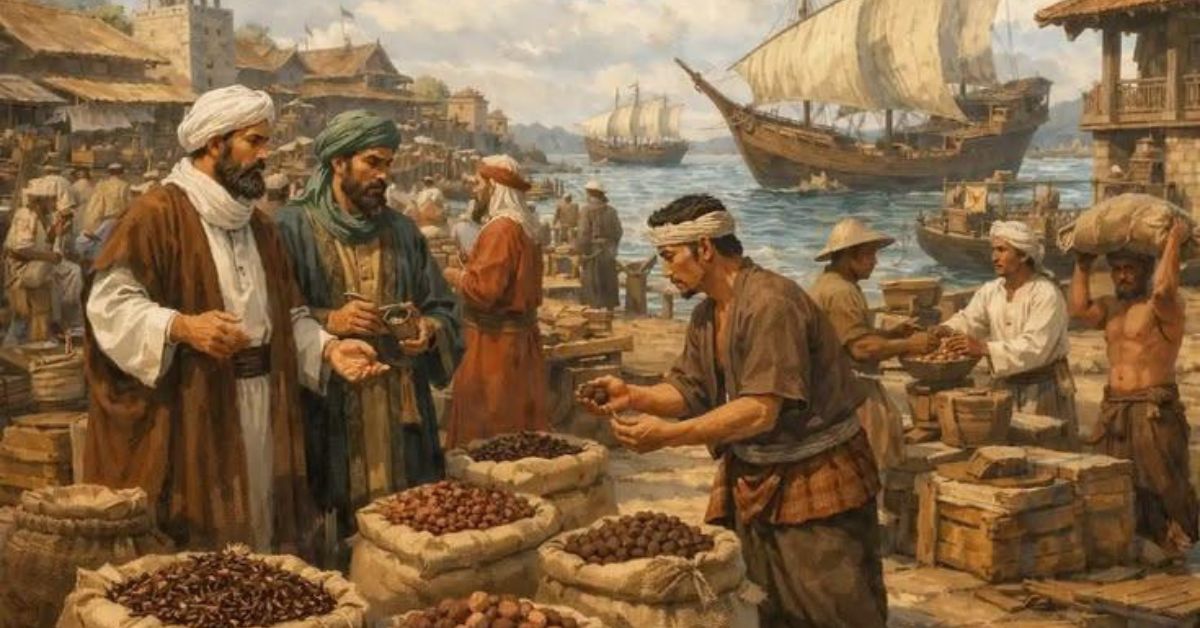
The Indonesian Archipelago, particularly through the Strait of Malacca, served as one of the world's busiest maritime trade routes. This strategic location attracted international merchants who conducted commercial activities at numerous ports throughout the region. These merchants not only exchanged goods but also established close social relationships with local communities living around the ports.
Through these interactions, local populations gained access to new knowledge, ideas, and broader global perspectives. Regardless of whether one follows the Arab, Gujarat, Persian, or Chinese theory of Islam's arrival, these perspectives share a common element: Islam was introduced by Muslim merchants who came from their respective regions to trade in the archipelago. Consequently, the spread of Islam occurred naturally through continuous socio-economic interactions between Arab, Gujarati, Persian, and Chinese merchants and the indigenous communities.
The Process of Islamization in the Indonesian Archipelago
The socio-economic interactions between foreign Muslim merchants and local communities marked the beginning of Islamization in the Indonesian Archipelago. Over time, many merchants established close relationships with local residents, including through intermarriage, giving rise to Muslim families and communities that continued to grow across the region.
Beyond trade and marriage, education and the arts also played significant roles in disseminating Islamic teachings. During this period, numerous Arabic texts were translated into Malay, making Islamic knowledge more accessible to local populations. Islamic boarding schools (pesantren) were established as centers of religious education, while music, performing arts, and local cultural traditions were creatively adapted as effective media for Islamic preaching. Furthermore, political relationships between Muslim merchants and local kingdoms encouraged many rulers who had previously adhered to Hinduism or Buddhism to embrace Islam, accelerating its spread throughout the archipelago.
The Islamization of various regions in the Indonesian Archipelago cannot be separated from its historical role as a global maritime trading hub. The socio-economic interactions between merchants from Arabia, China, Persia, and Gujarat and the indigenous populations of port cities became the foundation for the spread of Islam. Consequently, the Islamization of the archipelago stands apart from many other regions of the world because it was achieved primarily through peaceful interaction, cultural exchange, and mutual adaptation rather than military conquest or coercion. This historical process has also contributed to the development of Indonesia's long-standing tradition of religious tolerance and cultural diversity.
References
Amalia, N. J., Risma, & Idrus, L. (2026). Masuknya Islam di Nusantara: Teori, saluran, dan pola islamisasi. JHUSE: Journal of Humanities, Social Sciences, and Education, 2(3), 1–12.
Erasiah. (2018). Korelasi perdagangan dengan islamisasi Nusantara. Majalah Ilmiah Tabuah: Ta'limat, Budaya, Agama dan Humaniora, 22(2), 29–42. https://doi.org/10.15548/tabuah.v22i2.30