Tarjamah Study Program Holds Public Lecture on Nahwu-Shorof and Accurate Text Translation
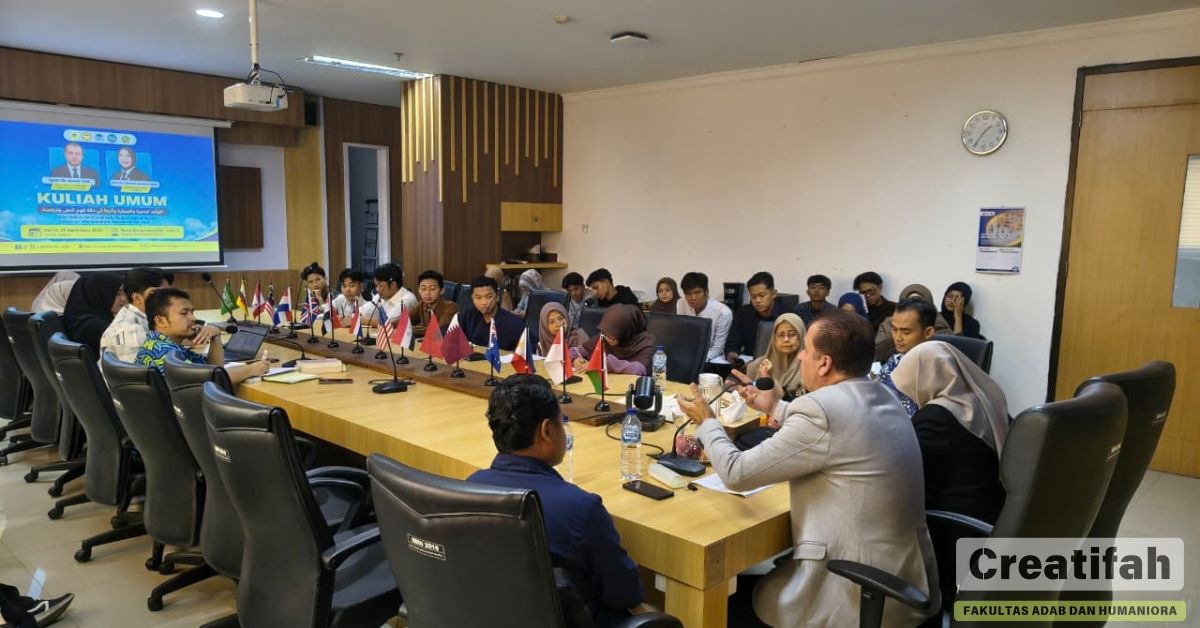
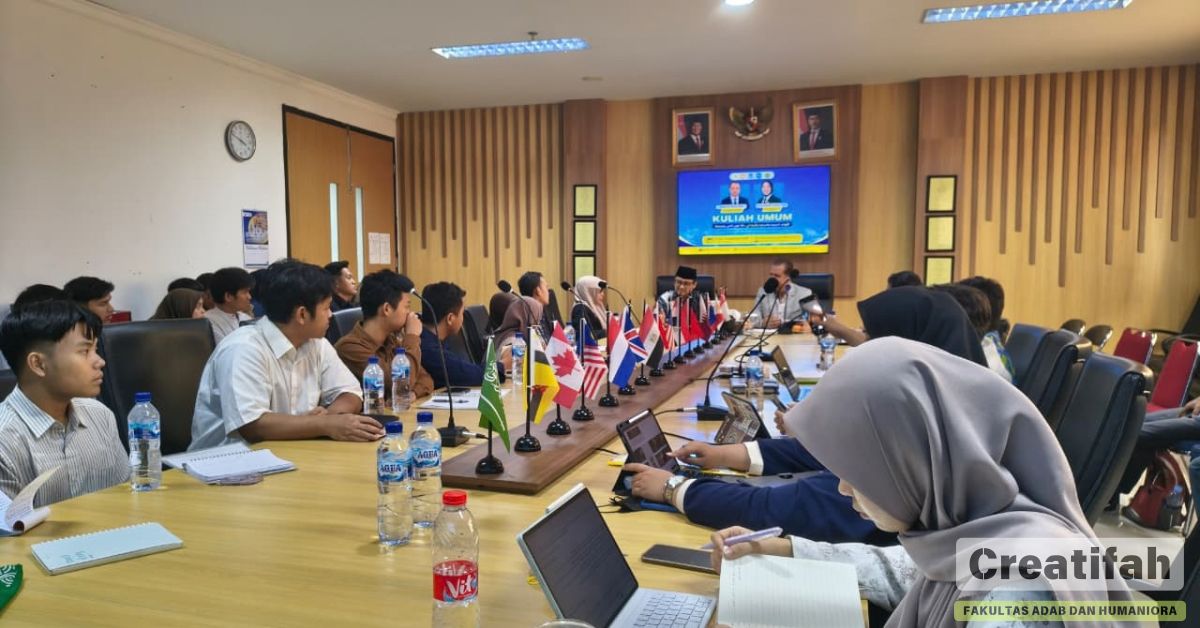
South Tangerang, FAH Online – The Tarjamah Study Program, Faculty of Adab and Humanities (FAH), UIN Syarif Hidayatullah Jakarta, held a public lecture entitled “The Principles of Nahwu and Shorof and Their Influence on Accuracy in Understanding and Translating Texts” on Thursday (September 24, 2026), at the FAH Main Meeting Room, UIN Syarif Hidayatullah Jakarta.
The public lecture featured Dr. Aiman Yasin, a Nahwu scholar from Bilad as-Sham University in Damascus, Syria, as the keynote speaker. The event was also attended by the Dean of FAH UIN Syarif Hidayatullah Jakarta, Dr. Ade Abdul Hak, M.Hum., CIQnR., Head of the Tarjamah Study Program, Prof. Dr. Darsita Suparno, S.S., M.Hum., as well as lecturers and members of the Tarjamah academic community.
In his presentation, Dr. Aiman Yasin invited students to understand the principles of Nahwu and Shorof not merely from a theoretical perspective, but also through proper pronunciation based on the lahjah, or accent, of native Arabic speakers. Such understanding is important for Tarjamah students because accurate grammatical structures and pronunciation are closely related to their ability to comprehend and translate Arabic texts accurately.
In addition to discussing Modern Standard Arabic (al-fushah), Dr. Aiman also introduced the students to Arabic 'amiyah, or colloquial Arabic. The discussion covered vocabulary, articulation, and the characteristics of its use in everyday communication across different Arab regions.
According to Dr. Aiman, Arabic 'amiyah varies considerably from one region to another. Syrian and Levantine lahjah, for example, have their own distinctive characteristics, as do colloquial varieties spoken in other parts of the Arab world. These differences can be found not only in vocabulary but also in pronunciation and language structures.
One of the examples he presented was the pronoun “هما”, which in al-fushah is used as the third-person dual pronoun. In some varieties of Arabic 'amiyah, however, this specific form is not commonly used, and speakers tend to use “هو” and “هم” instead.
Dr. Aiman also demonstrated changes in the articulation of certain words in colloquial Arabic. The word “كثير”, for instance, may be pronounced differently in everyday speech. He also introduced several colloquial expressions, including “شو”, meaning “what”; “شوف”, meaning “look”; “خرمشة”, meaning “scratching”; “عَم”, referring to “now”; and “منسطِّيح”, referring to the activity of lying down or relaxing.
The students were also introduced to phonetic characteristics of Arabic 'amiyah, including the pronunciation of the Arabic letter “ق”, which in certain dialects may be realized as a glottal stop.
'Amiyah for Informal Communication
During the discussion session, Dr. Aiman Yasin explained the role of Arabic 'amiyah in Arabic language learning. He stated that students should be familiar with 'amiyah, particularly to support informal communication with native Arabic speakers. Nevertheless, he emphasized that proficiency in al-fushah should remain the primary foundation.
“Levantine Arabic is for the people of the Levant, while Egyptian colloquial Arabic is for Egyptians,” he explained.
He further noted that colloquial Arabic differs across regions. “The colloquial Arabic spoken in North Africa is different from that spoken in the Levant,” he said.
Such diversity, according to Dr. Aiman, is one of the challenges in learning Arabic 'amiyah. Therefore, Tarjamah students need to view 'amiyah as complementary knowledge for communication purposes, while mastery of al-fushah should remain a priority.
“Wherever you go in the Arab-speaking world, using al-fushah is sufficient. They will understand you; there is no need to use 'amiyah,” he said.
Arabic as a Source of Pride for Muslims
At the end of the public lecture, Dr. Aiman Yasin encouraged students to continue studying and deepening their knowledge of Arabic. He emphasized the important role of Arabic in understanding the Islamic intellectual and scholarly heritage.
He described Arabic as part of the marwah, or dignity and honor, of the Muslim community. Therefore, students, particularly those specializing in Tarjamah, are encouraged to continuously develop their Arabic proficiency in grammar, text comprehension, pronunciation, and broader linguistic knowledge.
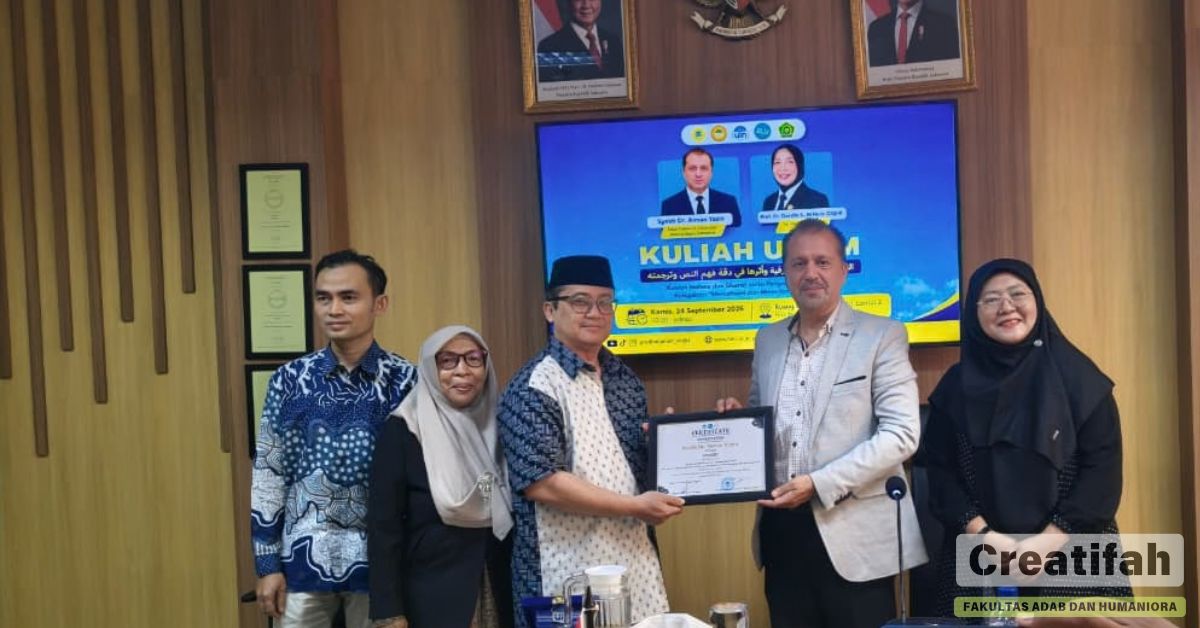
The public lecture concluded with the presentation of a commemorative gift from the Faculty of Adab and Humanities, UIN Syarif Hidayatullah Jakarta, to Dr. Aiman Yasin, followed by a group photo with the faculty leadership, lecturers, and members of the Faculty of Adab and Humanities academic community.
Writer: Surya Ananta Wijaya Kusuma
Documentation: