
Strengthening Digital Security Awareness: HMPS IP’s IGC 2 Discusses Data, System, and Library User Protection
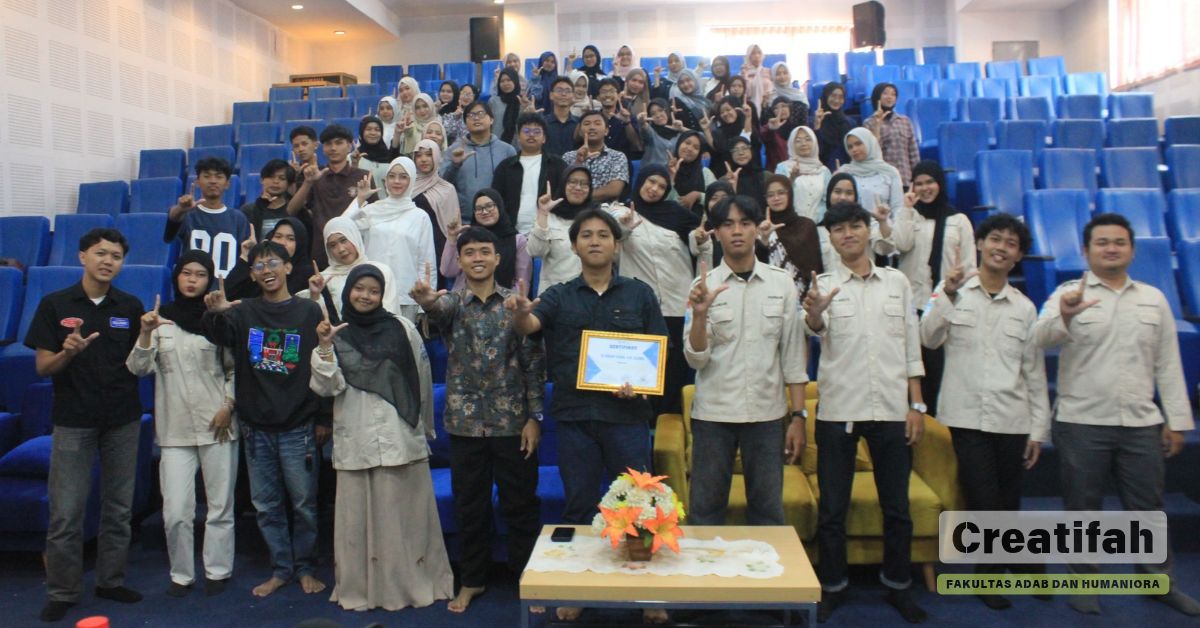
Ciputat, FAH Online News – The Library and Information Science Student Association (HMPS Ilmu Perpustakaan) of UIN Syarif Hidayatullah Jakarta held the second IPI Growth Class (IGC 2) on Wednesday, October 21, 2026. The event took place at the Abdul Ghani Theater on the fifth floor of the Faculty of Adab and Humanities (FAH) under the theme “Secure the Library: Protecting Data, Systems, and Users.” The program served as an educational platform for students to broaden their understanding of the importance of protecting data, systems, and library users in the digital era.
More than 50 participants attended the event, which was also attended by Fathan Rangga Ifari, Vice Chairperson of HMPS Ilmu Perpustakaan, and Fatma Ramadhani, Chair of the IGC 2 Organizing Committee. The session featured Al Muhdil Karim, S.IP., M.Hum., as the speaker.
The event began with an introduction to IPI Growth Class 2, a program organized by HMPS Ilmu Perpustakaan through its Human Resources Development Department (PSDM). The program provides students with a learning platform to expand their knowledge and strengthen their preparedness for developments in the library and information science profession.
Opening remarks were then delivered by Fathan Rangga Ifari, Vice Chairperson of HMPS Ilmu Perpustakaan.
“Through IGC 2, I hope students will gain a deeper understanding of the importance of digital security, particularly in library management. As future librarians, we are expected not only to manage information effectively but also to understand how to secure data and protect users’ privacy amid ongoing technological developments,” Fathan said.
The theme “Secure the Library: Protecting Data, Systems, and Users” was chosen to address security issues that have become increasingly relevant as digital technology is integrated into library services. Information management now involves more than storing and retrieving collections; it also encompasses protecting user data, securing access to systems, and promoting responsible technology use.
The program continued with a presentation by Al Muhdil Karim, S.IP., M.Hum. During the session, participants explored the importance of safeguarding library data and systems and learned how digital threats can disrupt service continuity and undermine user trust. The discussion of data, system, and user protection reinforced the importance of information security in modern library management.
In his presentation, Al Muhdil Karim emphasized that digital security cannot rely solely on antivirus software and firewalls. Instead, security must be developed as an ongoing process involving knowledge, awareness, and human resource preparedness. He explained that security depends not only on the sophistication of technology but also on the understanding and behavior of the people who use the systems.
He outlined three key stages of cybersecurity: prevention, detection, and response. Prevention involves identifying potential attacks and reducing risks before an incident occurs. Detection involves monitoring systems and networks to identify unusual activities. Response refers to the actions taken after an attack has occurred, taking into account its impact on essential operations and the services that must remain available.
To illustrate the consequences of cyberattacks, the speaker discussed the ransomware incident affecting the Seattle Public Library. According to the presentation, approximately 27,000 people were affected by a data breach, while digital services were disrupted for more than a month. The library’s catalog and e-books became inaccessible, public computers and Wi-Fi were temporarily disabled, and book-lending services had to be handled manually. The incident demonstrated how cyberattacks can compromise user privacy, disrupt service continuity, and erode public trust.
The speaker also explained the various motives behind cyberattacks, ranging from financial gain and reputation-seeking to national interests, such as cyber espionage, and simple curiosity about technology. As protective measures, small libraries can begin by implementing strong passwords, conducting regular data backups, and keeping their systems and antivirus software up to date. Medium-sized libraries should separate public networks from internal networks and provide staff training, while libraries with high service traffic require stronger network monitoring and protection. He also reminded participants that cyberattacks can begin with seemingly simple actions, such as opening an email attachment or clicking a malicious link.
To assess participants’ understanding, the program began with a pre-test and concluded with a post-test. These assessments were used to evaluate improvements in participants’ knowledge and understanding after attending the session.
Through IPI Growth Class 2, HMPS Ilmu Perpustakaan hopes to strengthen students’ understanding of the importance of information security in the digital era, both in academic life and in professional library practice. Awareness of data confidentiality, vigilance against digital threats, and responsible system use are essential skills for students preparing to face the challenges of information management. The program also reflects the PSDM Department’s commitment to providing student development activities that respond to technological advances and the evolving needs of the Library and Information Science field.
Written by: Fatma Ramadhani / Kasih Nur