
Introduction to Academic and Student Culture within the Faculty of Adab and Humanities
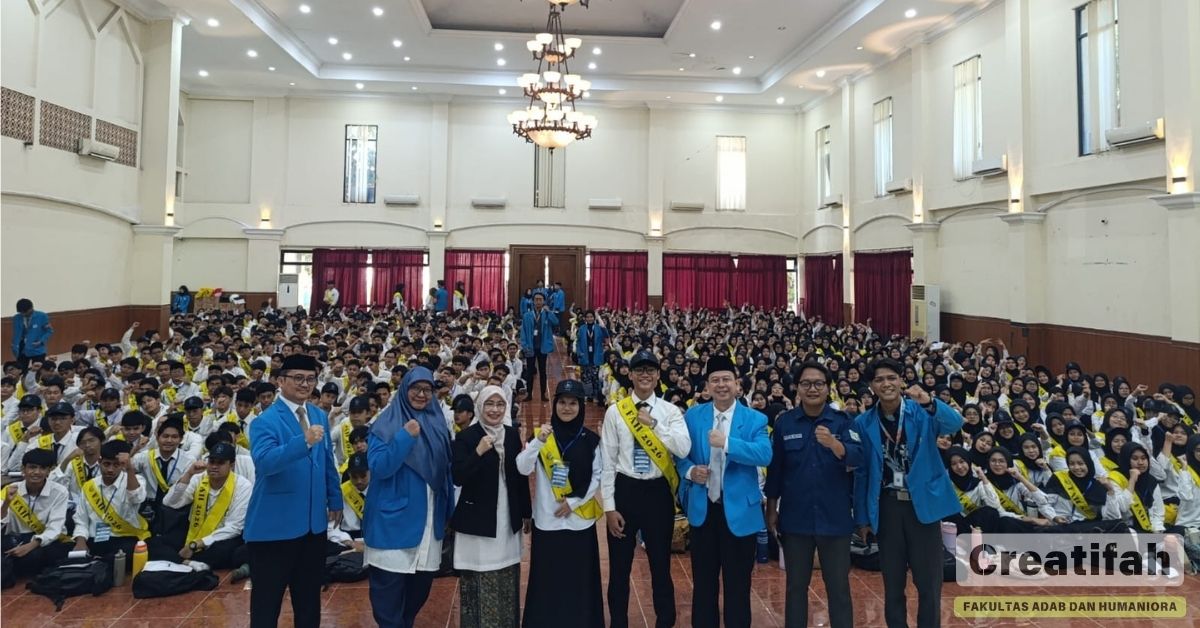
South Tangerang, FAH News Online – New students of the Faculty of Adab and Humanities (FAH) participated in a series of PBAK FAH 2026 activities. On the third day of the UIN Jakarta PBAK program, the activities were held at the Syahida Inn Building on Friday, August 28, 2026. The program was organized to introduce the 2026 FAH new students to the academic and student environment of the Faculty of Adab and Humanities and to help them prepare themselves before entering university life.
The program began at 6:00 a.m. and was attended by the Deanery of the Faculty of Adab and Humanities, Prof. Dr. Hendrawati, M.Si., Professor of Environmental Chemistry at UIN Jakarta; H. Adi Tiya Wijaya, S.H., Member of the Tangerang Regency Regional House of Representatives (DPRD); and Indonesian activists Abdurrohman and Abdillah Onim. The event was warmly welcomed by the Chairperson of DEMA FAH, Muhammad Ibnu Chajar, along with the entire PBAK FAH 2026 organizing committee.
In his remarks, Dr. Ade Abdul Hak, S.Ag., S.S., M.Hum., CIQnR, stated that the Faculty had provided financial support for students to produce scholarly articles and had also given students the opportunity to replace their undergraduate thesis as a final project with an article, book, or other academic work.
“We have provided FAH students with the opportunity to replace their final project, which traditionally takes the form of an undergraduate thesis, with an article that must be published in a national or international journal. We have also provided financial support for FAH students in developing their articles,” he said.
Entrepreneurship Session
The event continued with an entrepreneurship session, which was organized in response to the direction of the Vice Dean III for Student Affairs and Cooperation, Prof. Usep Abdul Matin, S.Ag., M.A., M.A., Ph.D.
“The Faculty of Adab and Humanities has established numerous Memoranda of Understanding (MoUs) with government institutions at both the central and regional levels. However, only a small number of our alumni work in the government offices with which we have established MoUs. Most of our alumni pursue careers as entrepreneurs. Therefore, we strongly hope that PBAK can serve as a platform to prepare FAH students for the world of entrepreneurship,” he said.
During the entrepreneurship session, Abdurrahman, S.Hum., an alumnus of the Translation Studies Program at UIN Jakarta, emphasized the importance of FAH students understanding entrepreneurship, particularly because employment opportunities are increasingly limited. Students therefore need to begin thinking about creating employment opportunities themselves.
“Why do we need to understand entrepreneurship? Because the employment opportunities available today are very limited. Therefore, we need to start thinking about creating employment opportunities ourselves,” he said.
Entrepreneurship is not merely about establishing a new business. It also requires an understanding of risks and the ability to develop new innovations. He further emphasized the importance of starting to build a business while still in university.
“Entrepreneurship is not only about creating a new business, but also about taking measured risks and implementing innovations that can create broader opportunities. Therefore, it is very important for students to start developing a business while they are still in university,” he added.
Session on Palestine
The program continued with a discussion on the Palestinian issue. Indonesian activist Abdillah Onim explained his perspective on the resistance taking place in Gaza, describing it as resistance against Zionism and discussing the historical development of Zionist migration to Palestine.
“The resistance carried out by the Palestinian people in Gaza is resistance against Zionism. Zionism itself involved immigrants from various countries who migrated to Palestine. They began arriving in Palestine in the context of the developments following the Balfour Declaration in 1917, signed by British Foreign Secretary Arthur Balfour. Therefore, the resistance of the Palestinian people in Gaza is directed against the presence and existence of Zionist forces,” he said.
He also emphasized the importance of students developing broad perspectives in understanding religion and viewing religious issues from different perspectives and within different groups, so that social and religious harmony can be maintained.
“It is not only about relations between different religions; even within the same religion, we need to understand the various groups within Islam. In practicing our faith, of course, we should base ourselves on the Qur’an and the Sunnah of Prophet Muhammad (peace be upon him). Conflicts can occur not only between different religions but also within the same religion. Therefore, we need broad knowledge and understanding so that differences among groups within Islam do not become barriers to maintaining friendship and harmony,” he added.
UIN Jakarta Green Campus Session
The final session focused on the Green Campus program at UIN Jakarta. Prof. Dr. Hendrawati, M.Si., Professor of Environmental Chemistry at UIN Jakarta, explained that students can contribute to the Green Campus initiative simply by fulfilling their rights and responsibilities in accordance with the applicable student code of ethics.
“What should students do to support the Green Campus? Actually, it is quite simple. Students only need to fulfill their rights and responsibilities based on the code of ethics. The code of ethics has been in place since 2022. I would like to highlight several rights and responsibilities related to the Green Campus. First, students must be able to maintain security, peace, cleanliness, and environmental sustainability. Second, smoking is prohibited on campus. Cigarettes and vapes are treated the same way and are prohibited under our code of ethics,” she said.
The Green Campus program includes various activities, such as seminars and tree-planting initiatives, a waste bank, and the distribution of eco-friendly pencils. UIN Jakarta has also provided drinking-water refill stations to encourage students to reduce their use of plastic bottles and replace them with reusable tumblers. In addition, UIN Jakarta has its own Integrated Waste Management Facility (TPST), called Cipta Alam Lestari Terpadu (CALISA), where waste generated from Campuses 1, 2, and 3 is processed.
At the end of the event, a UIN Jakarta band performed several songs, marking the conclusion of the PBAK FAH 2026 activities.
Through this program, FAH hopes that new students will be able to prepare themselves before entering university life and develop clear goals for the next four years. With proper preparation from the beginning of their university journey, students are expected to make the most of their academic and personal development during their time at FAH.
Writer: Ahmad Daffa Rasyidi