
FAH Tarjamah Study Program Prepares Preparation of Superior Accreditation Documents Based on Worldwide Innovation
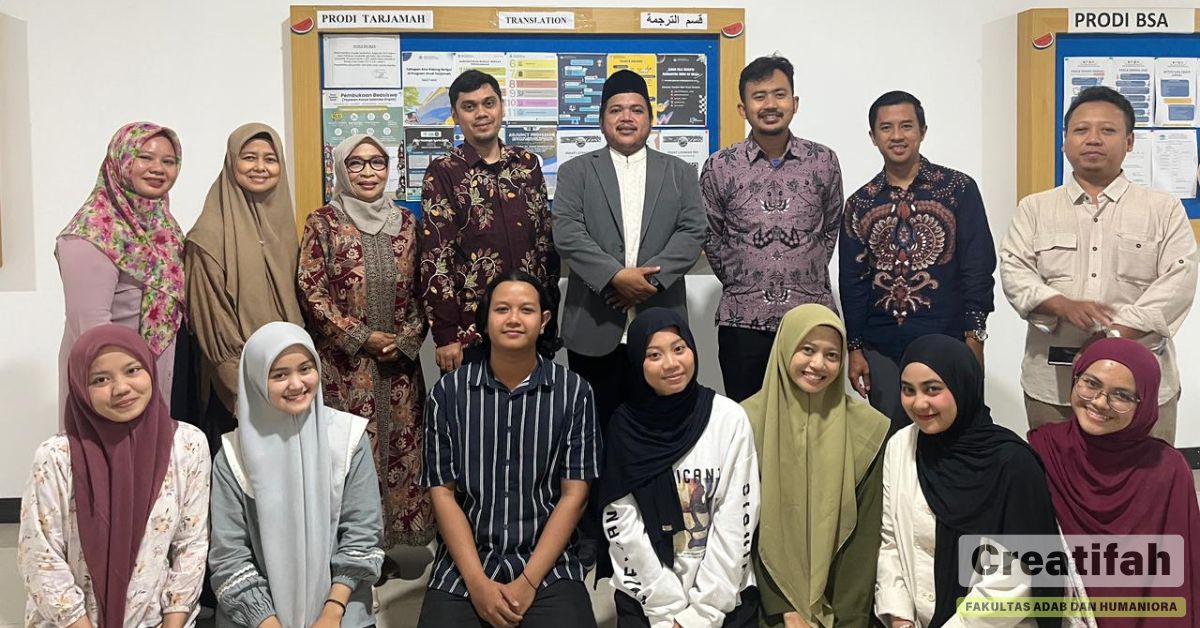
South Tangerang, FAH News Online — Tarjamah Study Program, Faculty of Adab and Humanities (FAH) UIN Syarif Hidayatullah Jakarta held a Coordination Meeting to Prepare Accreditation Documents for Tarjamah Study Programs with a vision of Worldwide Innovation. This meeting is a strategic step in ensuring academic readiness, human resources and completeness of accreditation documents in accordance with the latest BAN-PT provisions.
During the meeting, the Dean of the Faculty of Adab and Humanities (FAH) Dr. Ade Abdul Hak, S.Ag., SS, M.Hum emphasized that preparation for Tarjamah Study Program accreditation is part of the faculty's commitment to maintaining and improving academic quality in a sustainable manner. Accreditation is not only understood as fulfilling administrative requirements, but also as a strategic instrument to ensure the achievement of higher education standards, strengthening the Tridharma of Higher Education, as well as increasing the competitiveness of graduates at national and international levels.
In line with this, the Head of the Tarjamah Study Program, Prof. Dr. Darsita S, M.Hum said that the coordination meeting for the preparation of accreditation documents was a very important first step in ensuring that all aspects of the assessment could be met systematically and measurably. Prof. Darsita emphasized that the vision of the Tarjamah Study Program as a study program oriented towards global innovation in the world of education and research must be reflected clearly in all accreditation documents, both through curriculum, lecturer performance, student achievements, as well as research output and community service.
In the discussion regarding lecturers and workload, the meeting emphasized that the regulation of lecturer credits refers to Minister of Education and Culture Regulation Number 58 of 2018, provided that the lecturer's Tridharma load remains in the range of 12 to 16 credits per year. The distribution of the teaching burden is carried out equally among permanent lecturers before being allocated to non-permanent lecturers, with a maximum provision of 12 credits for non-permanent lecturers, and a mapping of the number of lecturers is carried out to ensure a proportional distribution of tasks.
The meeting also discussed the accreditation mechanism which currently uses four standards with a total of 63 assessment points that study programs must fulfill. A total of 63 points will be divided and distributed to six Tarjamah Study Program lecturers to prepare Study Program Performance Report (LKPS) and Self-Evaluation Report (LED) documents, utilizing digital platforms such as Google Sheets and Google Docs to support effective coordination and accuracy of data preparation.
In terms of academic aspects, all Tarjamah Study Program Semester Learning Plans (RPS) have been completely updated and declared complete in documents. The RPS is ready to be uploaded into the accreditation system as proof of the fulfillment of learning standards, with a target for applying for accreditation planned for April 2026 according to the predetermined schedule.
Representative of the Quality Assurance Institute (LPM) Riyan Adi Putra, M.Hum emphasized that the fulfillment of all superior indicators must be proven thoroughly and integrated. Several important aspects of concern include achieving a tracer study of at least 75% for TS-2, data on TS-3 graduates in the last three years, renewing functional lecturer positions at PDDIKTI, and fulfilling student achievements at at least five national and international levels as part of strengthening academic achievement.
Apart from that, quantitative data such as the number of new students, lecturer ratio, and student data in the last five years will be automatically withdrawn from PDDIKTI. In the future, the government will also strive for the integration of lecturer Tridharma data which includes teaching, research and community service through the SISTER and SINTA systems, while Internal Quality Assurance System (SPMI) documents will be provided by LPM as the institutional quality assurance unit.
This coordination meeting also noted that there were a number of community service activities that had involved Tarjamah Study Program students as proof of supporting the performance of lecturers and students. With thorough preparation, measurable document fulfillment, and synergy between study programs, faculties and LPM, the Tarjamah Study Program is optimistic that it will be able to achieve superior accreditation that reflects academic quality and the vision of Worldwide Innovation. (Nurul Aini)