Exploring the Harmony of Sound and Meaning in Qur’anic Rhetoric through the BSA UIN Jakarta Scientific Seminar
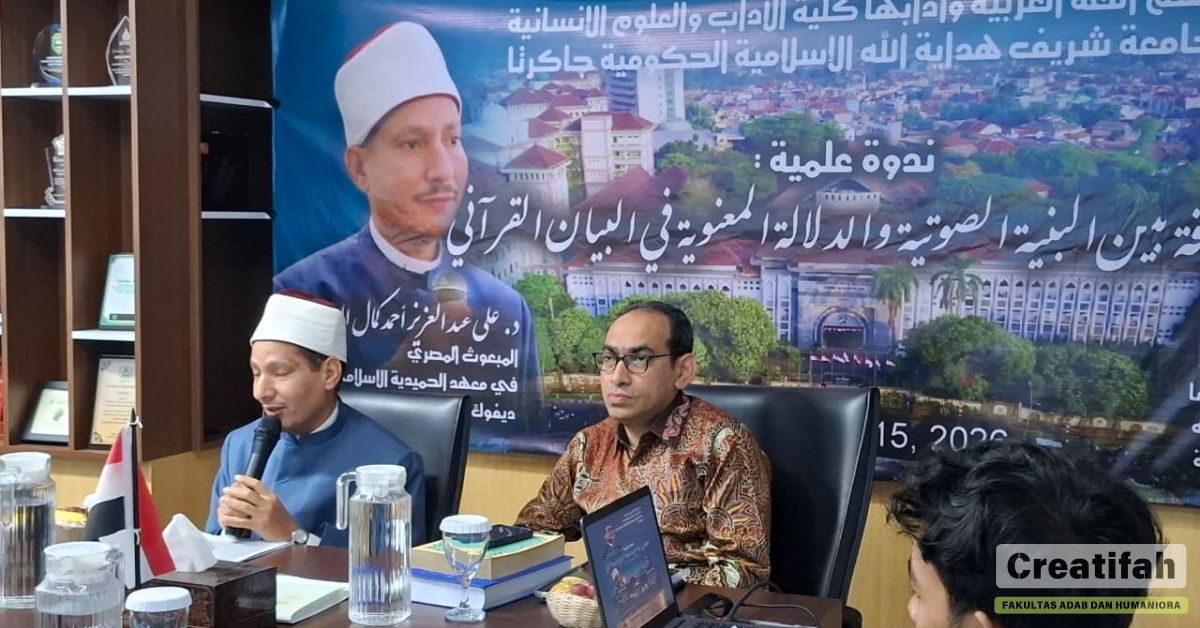
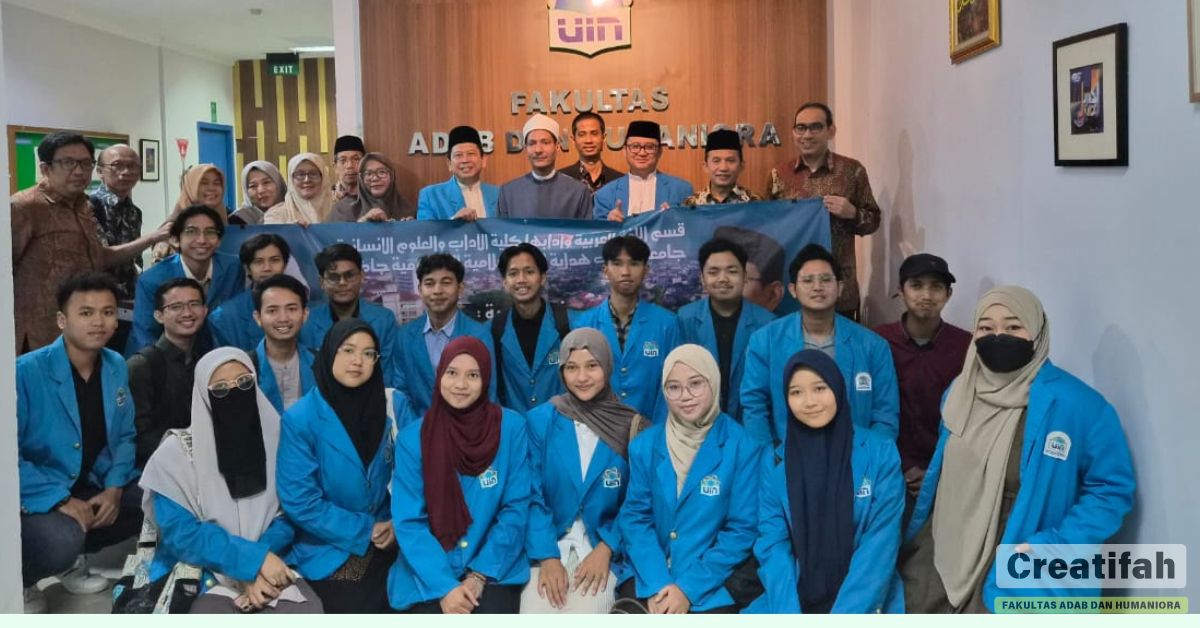
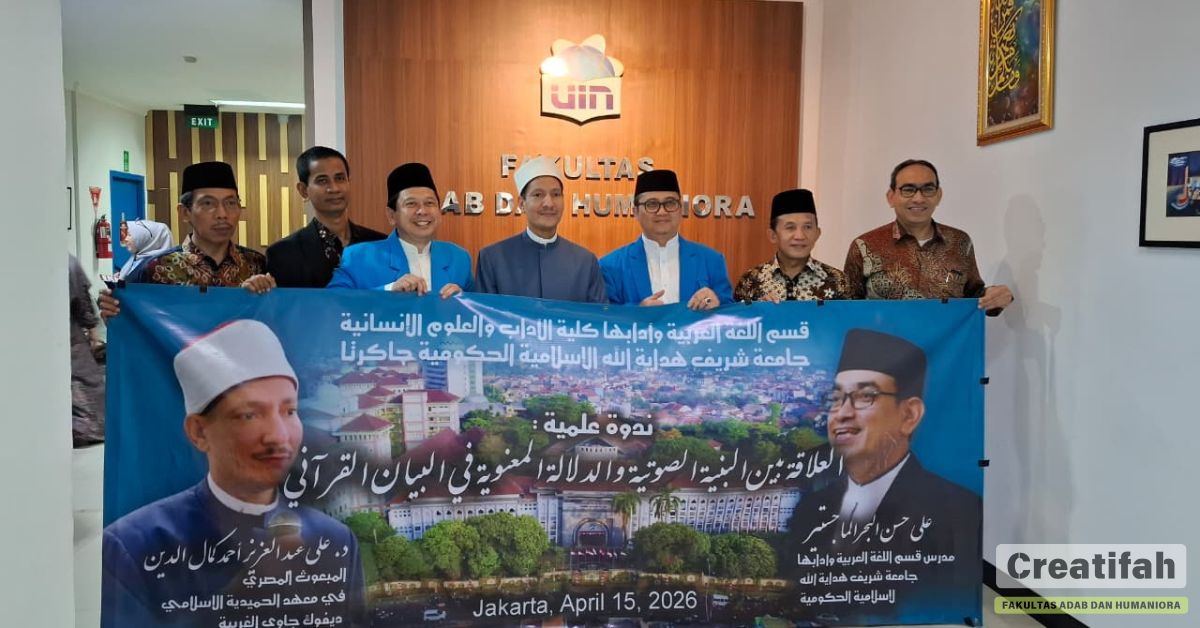
South Tangerang, FAH Online News — The Arabic Language and Literature Study Program, Faculty of Adab and Humanities (FAH), UIN Syarif Hidayatullah Jakarta, organized a scientific seminar entitled “The Relationship between Phonetic Structure and Semantic Meaning in the Rhetoric of the Qur’an” on Wednesday, April 15, 2026, at the Dean’s Office Hall of FAH UIN Jakarta.
The event featured two speakers: Dr. Ali Abdul Aziz Ahmad Kamaluddin, a representative from Egypt at Ma’had Al-Hamidiyah, Depok, and Ali Hasan Al-Bahar, M.A., a lecturer in Arabic Language and Literature at UIN Syarif Hidayatullah Jakarta. The seminar aimed to examine the relationship between sound (phonetics) and meaning (semantics) in the Qur’an as part of its divine rhetorical beauty.
In his remarks, the Dean of FAH UIN Jakarta, Dr. Ade Abdul Hak, S.Ag., S.S., M.Hum., emphasized that every letter in the Qur’an carries a profound dimension of meaning.
“Every letter in the Qur’an has a soul, and every soul has meaning. The Qur’an also possesses a therapeutic dimension, depending on how one absorbs and recites its verses. This is a responsibility for us, especially the academic community of Arabic Language and Literature, to present an understanding of the Qur’anic language that is accessible to the broader public, including lay audiences,” he stated.
At the end of his remarks, he expressed hope that the seminar would spark further discussions and encourage broader collaboration. He also highlighted the importance of implementing academic knowledge directly within society as part of building an Islamic civilization oriented toward well-being in both worldly life and the hereafter.
During the presentation session, Dr. Ali Abdul Aziz Ahmad Kamaluddin explained that the Qur’an is a text of extraordinary linguistic beauty, where sound, meaning, and context are harmoniously integrated. He emphasized that phonetic structure—including sound arrangement, pronunciation, and articulation points—plays a crucial role in shaping semantic meaning in the Qur’an.
As an example, he cited the verse “yursalu ‘alaykuma shuwāẓun min nār”, in which the word “shuwāẓ” carries fricative sound characteristics that evoke the image of intensely spreading flames. According to him, these sounds function not only as linguistic elements but also reinforce meaning in both visual and emotional dimensions.
Meanwhile, Ali Hasan Al-Bahar, M.A., highlighted the importance of understanding the relationship between phonetic structure and semantic meaning in the Qur’an. He emphasized that each letter and sound in the Qur’an has interconnected characteristics and meanings, opening wide opportunities for developing contemporary linguistics-based interpretation methodologies.
He also clarified a common misconception that the Qur’an was revealed to an “ignorant” society.
“The term jahiliyyah does not refer to intellectual ignorance, but rather to the absence of divine guidance (Islam). At that time, Arab society was known for its highly advanced literary tradition, as reflected in works such as the Mu‘allaqat and the existence of literary markets,” he explained.
During the discussion session, participants raised questions regarding the application of phonetic and semantic approaches in contemporary Qur’anic interpretation and the challenges involved. Responding to this, Ali Hasan Al-Bahar stated that one of the major challenges is the declining mastery of classical Arabic, especially among younger generations.
“Therefore, it is essential to return to the primary sources—the Qur’an and Sunnah—and strengthen the understanding of classical Arabic (fusha), which is the key to deeper comprehension of the Qur’an,” he explained.
The seminar was conducted interactively, featuring active discussions and Q&A sessions that were enthusiastically received by participants. This activity is expected to strengthen the academic understanding of the FAH UIN Jakarta community in Qur’anic linguistic studies and to further develop Arabic language studies as a pathway to comprehending divine revelation more comprehensively.
Authors: Ruhama R Salsabila / Kasih Nur / Deny Saputra
Documentation: