
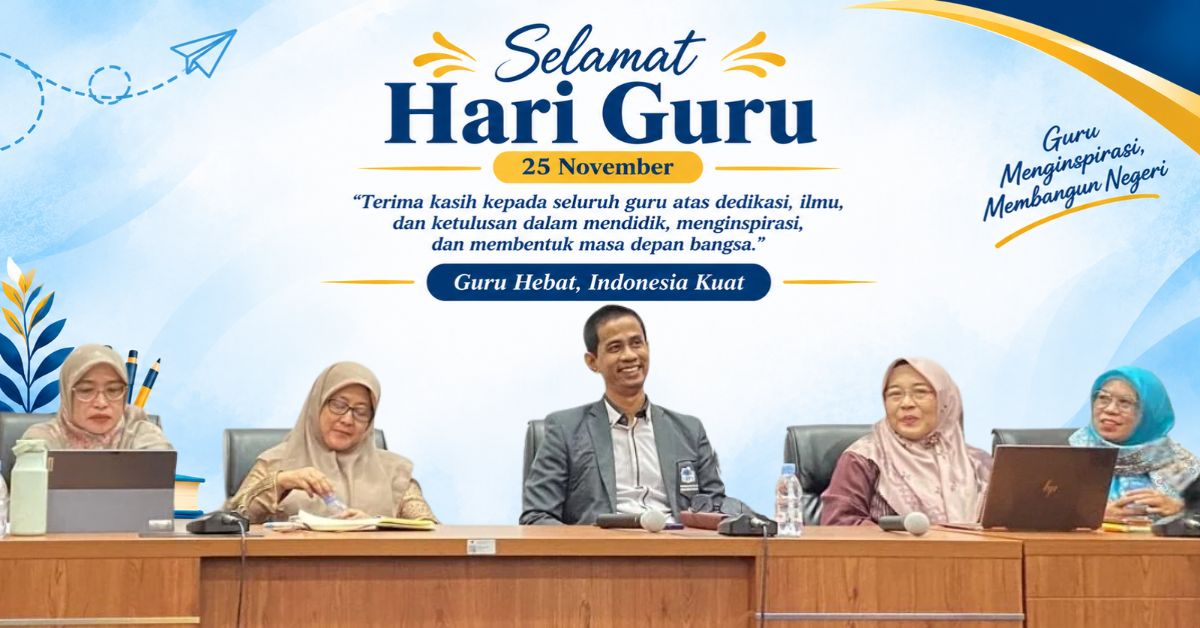
Commemorating National Teachers’ Day: University Lecturers Are Our Teachers Too!
By: Maia Az Zahra
Every November 25, Indonesia commemorates National Teachers’ Day (HGN). This occasion is always associated with various heartfelt celebrations, ranging from flag-raising ceremonies and the giving of flowers to an outpouring of messages of gratitude on social media for teachers at the kindergarten, elementary, junior high, and senior high or vocational school levels.
However, behind the enthusiasm of these celebrations, an invisible psychological and cultural boundary often emerges among students pursuing higher education. Upon entering university, many students unconsciously begin to distinguish between the identities of a “teacher” and a “lecturer.” The way they address educators changes, communication becomes more distant, and the essence of teaching is often reduced to mere administrative matters related to university courses. In fact, when examined from the perspective of their fundamental meaning and function, university lecturers are our teachers too.
Redefining the Meaning of “Teacher”: More Than Just a Title
Etymologically and historically, the word guru in the Nusantara tradition—particularly in Javanese culture—is commonly associated with the expression digugu lan ditiru (someone whose words are trusted and whose conduct is worthy of emulation). In a broader context, a teacher is anyone who imparts knowledge, shapes character, and guides individuals from ignorance toward intellectual enlightenment.[1]
According to Law of the Republic of Indonesia Number 14 of 2005 concerning Teachers and Lecturers, both teachers and lecturers are classified as professional educators. Article 1, paragraph (1), states that a teacher is a professional educator whose primary responsibilities include educating, teaching, guiding, directing, training, assessing, and evaluating students. Meanwhile, paragraph (2) defines a lecturer as a professional educator and scientist whose primary responsibilities are to transform, develop, and disseminate knowledge through education, research, and community service.[2]
These legal definitions clearly demonstrate that the essence of a lecturer's profession is essentially an extension of the role of a teacher: teaching and educating. The differences lie only in the level of education, the degree of independence expected of learners, and the complexity of the knowledge being explored.
Conclusion
National Teachers’ Day is not an exclusive celebration reserved solely for primary and secondary educational institutions. November 25 is a special day for everyone who dedicates their lives to literacy, intellectual enlightenment, and the emancipation of the nation's collective intellect—including lecturers in university classrooms.
It is time to break down these mental barriers. Lecturers are our teachers, guides to intellectual growth, and beacons of civilization at the higher education level. Happy National Teachers’ Day to all teachers in schools and lecturers at universities everywhere. Your dedication is the foundation upon which a just and prosperous future for the nation is built.
References:
[1] Koentjaraningrat, Kebudayaan, Mentalitet dan Pembangunan (Jakarta: Gramedia Pustaka Utama, 2004), p. 145 (on the cultural philosophy of teachers in the Nusantara tradition).
[2] Republic of Indonesia, Law Number 14 of 2005 concerning Teachers and Lecturers, State Gazette of the Republic of Indonesia Year 2005 Number 157, Supplement to the State Gazette of the Republic of Indonesia Number 4586, pp. 2–3.