
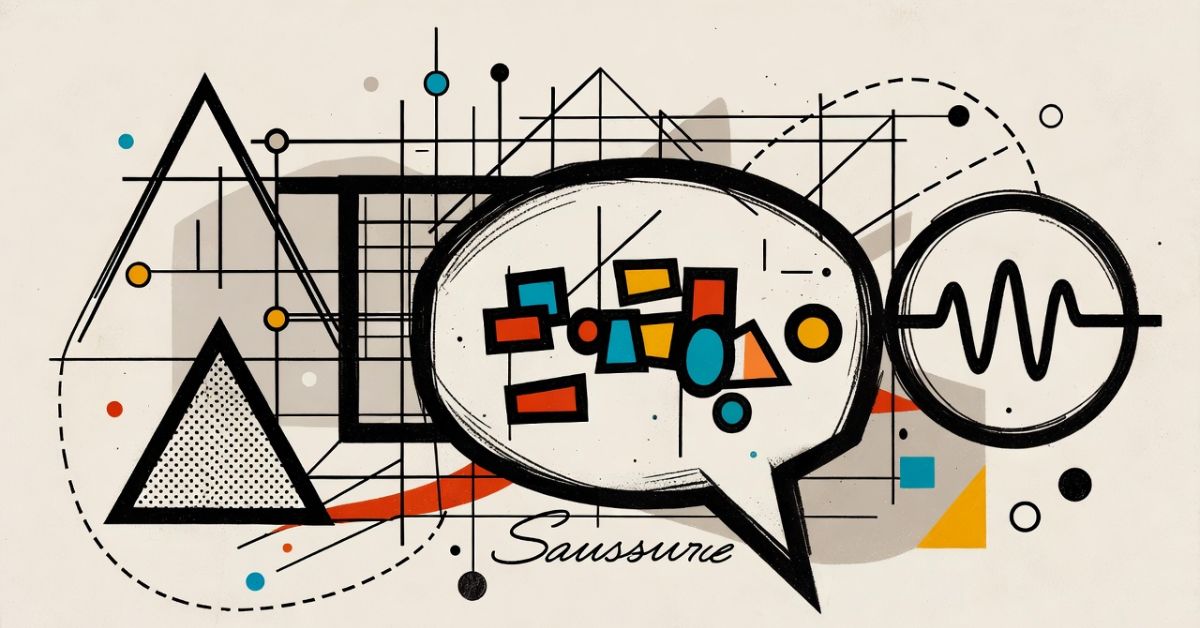
Behind the Veil of Language and Signs
By: Andika Pratama
As social beings, humans have a powerful natural impulse to communicate their feelings and ideas to others in their everyday lives. This communicative activity involves complex mechanisms that often go unnoticed because they have operated automatically since childhood and continue into adulthood. We use various sounds and visual symbols to represent the reality that exists in our minds so that our messages can be understood by others. This process of information exchange reflects a close relationship between language as a social tool, signs as a means of connecting substance with ideas, and thought as the center of information processing. If we examine this phenomenon more deeply, we will find that these three elements mutually influence one another and shape the way we understand the world. In linguistic terms, language is more specifically defined as a system of meaningful and articulated speech sounds. These symbols are arbitrary because there is no inherent or necessary relationship between a word and the physical object to which it refers. In other words, the particular form used to refer to a particular concept is collectively determined by society.
The World of Signs and the Production of Meaning
Within the field of linguistics, there is an intriguing area of study concerning an element that is deeply embedded in our everyday lives and constantly interacts with us, yet often goes unnoticed: the study of signs, or semiotics. Ferdinand de Saussure, also known as the father of modern linguistics, explained that a sign consists of two inseparable aspects: the signifier, which refers to the material aspect such as sound or image, and the signified, which refers to the mental concept associated with that sound or image. These two aspects cannot be separated because they jointly constitute the identity of a sign in our minds during communication. This unique relationship enables us to imagine an abstract concept even when the physical object is not present before us. Thus, signs function as an important bridge connecting the physical world outside ourselves with the mental world within our minds.
For example, suppose you go to a nearby café or coffee shop and see the words “hot black coffee.” Even without seeing a cup of coffee, your mind immediately evokes the strong aroma, the refreshing bitter taste, and the hot steam rising from the surface of the drink. Why does this happen? It is because the expression “hot black coffee” consists of a signifier—the sequence of letters and words displayed on the menu—and a signified—the complete mental concept of the beverage that is instantly formed in your mind. The arbitrary relationship between the signifier and the signified therefore enables communication to take place effectively even when the physical object, namely the coffee, is not present before our eyes. Consequently, signs function as a primary link between the real external world and the world of thought within our minds. They allow us to understand one another’s ideas, feelings, and experiences without having to display the actual object every time. When this concept is applied to other words such as “home” or “love,” we can see how powerful signs are in shaping shared understanding in everyday life.
The Reciprocal Relationship with Thought
The relationship between language and thought has also been the subject of an interesting debate among scholars because the two appear to influence each other. Wilhelm von Humboldt argued that a society’s worldview and way of thinking are largely determined by the structure of the language it uses. This suggests that we are, in a sense, constrained by our own language when perceiving and categorizing the reality of the world.
Jean Piaget, however, held a different view, arguing that thought shapes language because language cannot exist without the thought that precedes it. According to Piaget, a child’s cognitive development influences the development of their linguistic abilities, particularly in understanding increasingly complex concepts. Another perspective attempts to bridge these two opposing positions by emphasizing a dynamic and gradual interaction between language and thought. Vygotsky proposed that, initially, thought and language develop separately before eventually converging and influencing each other at a particular stage of development. When the two become integrated, processes of verbal thinking and linguistic thought emerge, enabling humans to engage in complex reasoning.
A comprehensive understanding of language, semiotics, and thought provides insight into the true nature of human communication. We come to realize that every word we utter is the product of complex mental processes as well as long-established social conventions. The signs surrounding us are not merely passive, lifeless objects; rather, they are active means through which we construct our perception of reality. Therefore, studying the relationship among these three elements makes us more sensitive to the ways in which messages are interpreted and to how we interact with others. Ultimately, this awareness can improve the quality of our social relationships amid the diversity of interpretations and meanings that exist within society.
References
Hasbullah, M. (2020). Hubungan bahasa, semiotika dan pikiran dalam berkomunikasi. Al-Irfan, 3(1), 106–124.
Mudjiyanto, B., & Nur, E. (2013). Semiotika dalam metode penelitian komunikasi. Jurnal Penelitian Komunikasi, Informatika dan Media Massa, 16(1), 73–82.
Chandler, D. (2022). Semiotics: The Basics. Routledge.
Piaget, J. (2005). Language and Thought of the Child: Selected Works, Vol. 5. Routledge.
Vygotsky, L. S. (2012). Thought and Language (Vol. 29). MIT Press.
von Humboldt, W. (1996). From “Thought and Language” to “Thinking for Speaking.” In Rethinking Linguistic Relativity (p. 70).
Photo Source: Grok AI