
Ampera Bridge: The Mandate of the People’s Suffering and the Icon of the City
Ampera Bridge is a name that is very familiar to the people of Indonesia, especially to the people of Wong Kito Galo (a term used to refer to the people of South Sumatra). This bridge is the landmark of Palembang City, standing majestically above the winding Musi River, which further enhances its grandeur. For the people of Palembang, this bridge is a silent witness to the struggle of society in driving colonialism out of South Sumatra. The name “Ampera” was taken from the slogan born during the 1955 Asian-African Conference, namely “Amanat Penderitaan Rakyat” (The Mandate of the People’s Suffering). Over time, the bridge has evolved into a city icon that unites the past and the present.
The construction of the bridge began in 1962 and it was officially inaugurated on September 30, 1965, exactly 20 years after Indonesia’s independence. The project cost around 15 million US dollars, funded by Japanese war reparations. Its construction was planned as part of a national development project in the post-independence era and became one of the monumental projects glorified by Sukarno at the time. In fact, Sukarno himself directly designed the bridge and brought in experts from Japan to assist with its construction. It is said that the bridge was built using political prisoners from the Old Order era who were involved in the PRRI/Permesta rebellion (1958–1961). Thousands of people were forced to work under poor conditions without proper wages, and many prisoners died during the construction process. All of this was carried out as a form of “rehabilitation” or punishment for the rebels.
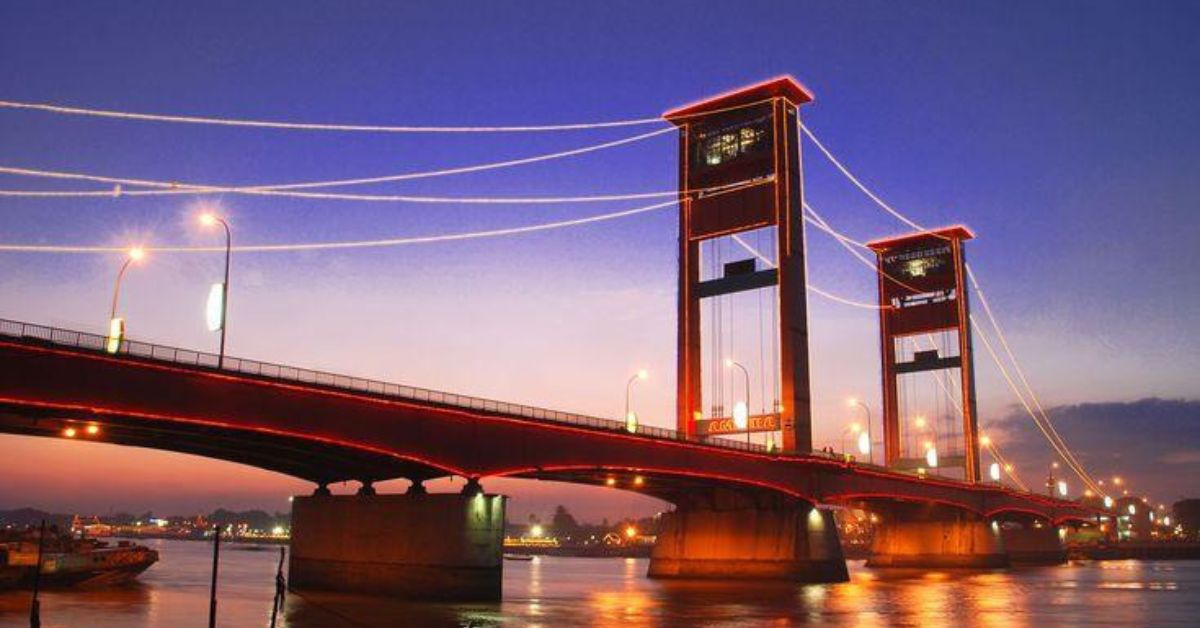
Despite the many stories surrounding it, the bridge still stands firmly above the Musi River. Initially, it was planned to be named Sukarno Bridge as a tribute to his contributions. However, the name was changed to “Ampera” to honor those who had fallen in the struggle for Indonesian independence. Officially inaugurated in 1965, the bridge measures 1,177 meters in length, 22 meters in width, and features two main towers standing 63 meters tall. At the time of its inauguration, it was the longest bridge in Southeast Asia and was widely recognized for its elegant design. The presence of two clock towers in the middle of the bridge further added an authentic and graceful impression. Combined with the flowing Musi River beneath it, the bridge offers a stunning panorama for anyone who sees it.
Today, exactly 61 years later, Ampera Bridge still stands proudly, displaying its magnificence and serving as a silent witness to how people in the past fought for independence from colonialism. Throughout these years, the bridge has undergone many changes, including its color, which has changed three times: gray (1965–1992), yellow (1992–2002), and red (2002–present). In the past, the center section of the bridge could be lifted to allow large ships to pass underneath. However, since the early 2000s, the lifting system experienced technical issues and was declared permanently nonfunctional. In 2023, a major renovation was carried out, enabling the system to function again, although only on special occasions rather than regularly as before. Today, the bridge is also decorated with beautiful lights that enhance its aesthetic appeal. This bridge teaches us that beauty can only truly be appreciated after many sacrifices have been made.
Today, the bridge has become a source of pride for the people of Palembang and serves as the main connection between the Ilir and Ulu areas of the city. Beyond being an icon, the bridge is also frequently used as a venue for cultural festivals in Palembang, making it deeply attached to the hearts of its people. Such is the reality that something we now admire for its grandeur often holds many dark stories behind it. Perhaps it is just a bridge, but through this bridge, the mandate of the people’s suffering was entrusted into a massive steel-and-concrete structure stretching across the Musi River, becoming a symbol of pride in the hearts of the people of Palembang.
Writer: Ahmad Daffa Rasyidi
Editor and Reviewer: Muhammad Husein Fadhlillah
References:
According to historians such as Asvi Warman Adam and Ahmad Yani Basuki (in the book Ampera Bridge: From Suffering to Pride).
The book History of Ampera Bridge by the Palembang Cultural Office.