
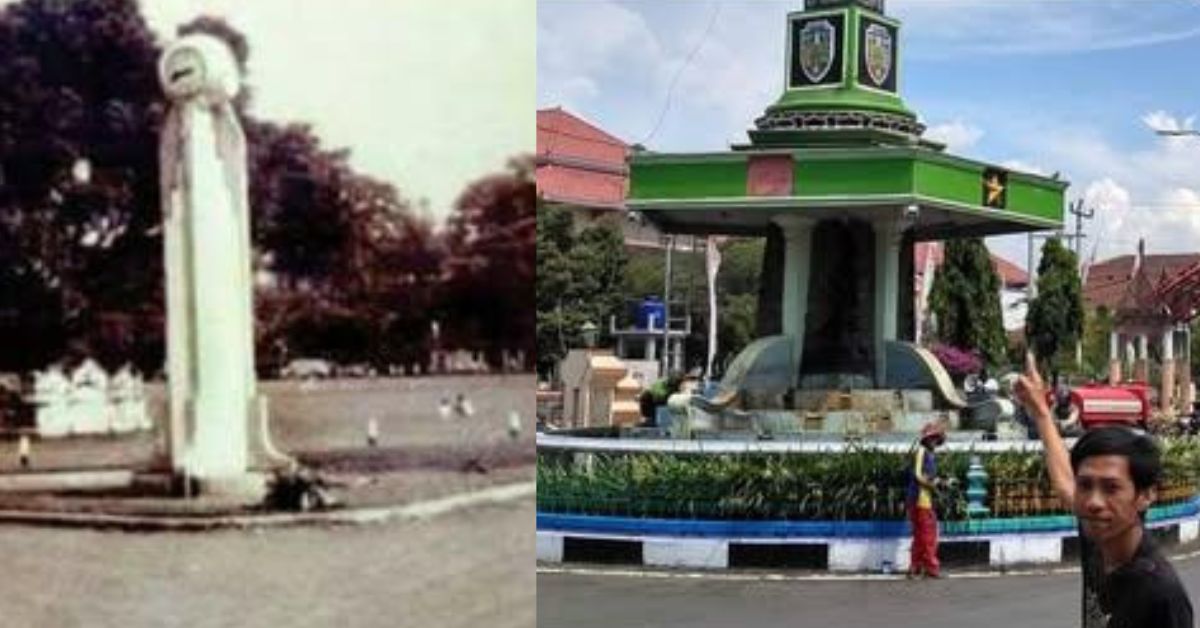
The Evolution of Public Space: The Transformation of the Square from a Power Center to a Recreation Center
Square spaces in traditional Javanese cities are often referred to as “heartbeats” ancient urban planning. Since the Majapahit era, every palace capital has been placed in a large field in front of the ruler's palace as a symbol of power. A historian named Olivier Johannes Raap noted that many cities in Java had square squares in the city center, surviving in front of the residence of the regional ruler. Majapahit era Negarakretagama texts mention Bubat Square (more profane; a place for people's parties) and Waguntur Square (more sacred; for coronation ceremonies and state events). Thus, since Hindu-Buddhist times, the square has doubled as a public arena as well as a sacred location, where people listen to the king's orders or witness state rituals. After the arrival of Islam and the formation of the Mataram Sultanate, the square has always been an integral part of the palace complex which symbolizes the unity between the human world and God in Javanese cosmology.
In the arrangement of the Yogyakarta palace, for example, Sultan Hamengkubuwono I carefully arranged the palace elements on an imaginary axis, including two squares (north and south) that decorated banyan trees and symbolic sand. The official website of the “Jogja” Palace confirms that since the Majapahit era, the existence of the square has always been preserved as a manifestation of the public space of the royal city. This meant that the concept of a square was adopted by almost all kingdoms in the archipelago, a large square in front of the central government that combined ritual and social functions. In the past, all palace relatives and small people came to the square to face the king or attend large ceremonies. Thus, the square is a sacred symbol in which the king's power radiates to the people. That's how mosques and pavilions were built on the side of the square as part of the accompaniment of religious events and royal customs.
When the Dutch East Indies came to power in the 19th century, the function of the square shifted. The layout of the square still reflects colonial rule, the resident assistant's house was built on one side of the square facing the regent's pavilion, while around it colonial offices such as prisons, markets, post offices and police stations were built. The native regent even placed an official residence “miniature palace” whose pavilion still faces the square, and continued to hold traditional ceremonies such as sodoran and grebeg there. Nevertheless, a historian, Handinoto, noted that the nature of the square became more popular during the colonial period. The square is no longer just a stage of sacred power, but is slowly turning into a kind of “civic space” or city plaza. “In colonial times this became a kind of ‘civic space’. Even at the end of colonial times it developed into a kind of plaza in Europe,” he wrote. In short, the square, which was once sacred, now also functions as a public space open to the public, a place for markets, marches or community meetings.
Many town squares were revitalized into parks and recreational sites. In Bandung, for example, the City Government renovated the Square in the 1950s into a large city park. Cultural heritage buildings such as pavilions were previously maintained, but the square has been opened to the general public. Likewise in Yogyakarta, Alun-Alun Selatan is lined up at night with street vendors, ornamental rickshaws and folk game rides. Similar phenomena are seen in many cities, the square's grounds are filled with family picnics, mass sports, music concerts or food bazaars. As President Joko Widodo emphasized, modern squares are public spaces, social spaces, cultural spaces. The open space in the city center, which was once filled with state rituals, is now the city's breathing space that accommodates everyday urban life. This change was marked by the opening of access for anyone and the addition of recreational facilities (fountains, ponds, performance stages, sports fields) which were completely absent from royal times.
Author: Inna Fatahna Hanifah
Editor and Reviewer: Muhammad Husein Fadhlillah
Reference
Handinoto. (1996). Development of Dutch colonial cities and architecture in Indonesia. Yogyakarta: Andi.
Lefebvre, H. (1974). The production of space. Oxford: Blackwell.
Nas, P. J. M. (2007). Indonesian cities: Potpourri. Yogyakarta: Gadjah Mada University Press.
Setiadi, E. M., & Kolip, U. (2011). Introduction sociology. Jakarta: Kencana
Photo Source:
https://www.facebook.com/infoseputarjepara/posts/-alun-alun-jepara-jaman-dulu-vs-jaman-nowalun-alun-jepara-jaman-dulu-dengan-alun/2408884592534938/