
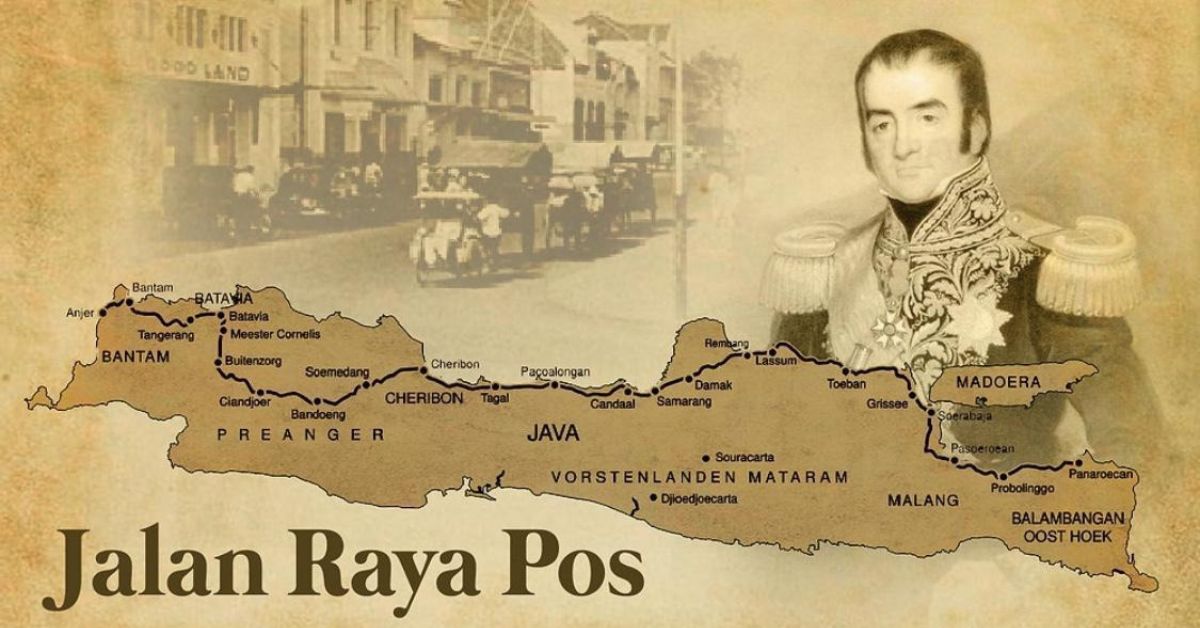
The Dark Side Behind Modernity: Suing Historical Romanticization in Our School Textbooks
For decades, the history curriculum in our schools seemed to be trapped in a monotonous pattern, memorizing dates, war locations, and the names of heroes. However, behind this series of year numbers, there is a fundamental problem that is rarely criticized, a hidden romanticization of the colonial period which is inserted through the development narrative, as well as a disregard for the roots of structural corruption that were born at that time.
One of the most obvious forms of romanticization is the way textbooks photograph infrastructure development. We are often taught that Herman Willem Daendels was the builder of the Postal Highway, or how the colonial government introduced the railway system. Subtly, this narrative creates a cognitive bias that colonization has a positive impact in the form of modernization.
In fact, as noted by historian Jan Breman (2014), this development is actually a brutal form of forced labor mobilization. Putting the achievement of infrastructure as the bright side of colonialism is a logical fallacy; it is not development for the people, but rather logistical efficiency for dredging more massive natural wealth. We tend to forget that every inch of the road is built on thousands of lives of people who have lost their human rights.
However, there is one darker and often absent historical fact in our textbooks, namely the problem of wage distribution. In some records of major infrastructure development, the colonials actually claimed to have allocated funds for wages and consumption of native workers. Ironically, the funds often evaporated and never reached the people because they were corrupted by local rulers or regents who interceded.
This point is crucial, but rarely explored critically. Corruption is not just the behavior of modern individuals, but the legacy of the colonial system which used local elites (priyayis) to oppress their own people for personal gain. To ignore this fact in the history books would be to romanticize that our enemies are only foreigners, whereas the disease of structural corruption has been fostered since that time through collaboration between colonists and local elites.
If we continue to present history as a black-and-white fairy tale, we fail to form a critical generation. History is not just about what happened, but about why it happened and who really benefited. Historian Sartono Kartodirdjo (1992) has long emphasized the importance of an Indonesian-centric approach, in which the small people are the main subject of history, not just a complement to the colonial policy narrative.
In the perspective of Frantz Fanon (1963), decolonialization is not only about expelling foreign soldiers, but also cleansing the mind of inherited systems of oppression, including a culture of feudalism and bureaucratic corruption that is still ingrained to this day.
It is time for history textbooks to stop being mere records of physical accomplishments or mourning. We need to change the paradigm that the advancement of infrastructure can never justify the removal of human dignity, and true independence means daring to dissect the ulcers of one's own nation's history honestly. By stopping romanticizing the past, we can become truly independent in thought and stop repeating patterns of oppression and corruption in the future.
Author: Nadhira Sonja Isinbayeva
Editor and Reviewer: Muhammad Husein Fadhlillah
Photo Source: https://static.wixstatic.com/media/2b11c5_3786f7f648b54cc19370488de930bde1~mv2.jpg/v1/fill/w_1000,h_563,al_c,q_85,usm_0.66_1.00_0.01/2b11c5_3786f7f648b54cc19370488de930bde1~mv2.jpg
REFERENCE
Breman, Jan. (2014). Colonial Benefits of Forced Labor: The Priyayi System in Java during the Forced Cultivation Period. Jakarta: Indonesian Torch Library Foundation.
Carey, Peter. (2012). The Power of Divination: Prince Diponegoro and the End of the Old Order in Java, 1785-1855. Jakarta: KPG.
Fanon, Frantz. (1963). The Wretched of the Earth (Painees on Earth). (Various Translation Editions).
Kartodirdjo, Sartono. (1992). Introduction to New Indonesian History: Social History 1900-1942. Jakarta: Gramedia Pustaka Utama.
Ricklefs, MC. (2008). A History of Modern Indonesia since c. 1200. Stanford University Press.
Toer, Pramoedya Ananta. (1980). Human Earth. Jakarta: Hasta Mitra.