
Joint Lecture of the Islamic History and Civilization Study Program at UIN Jakarta Held at Abdul Ghani Theater, Featuring Student Presentations
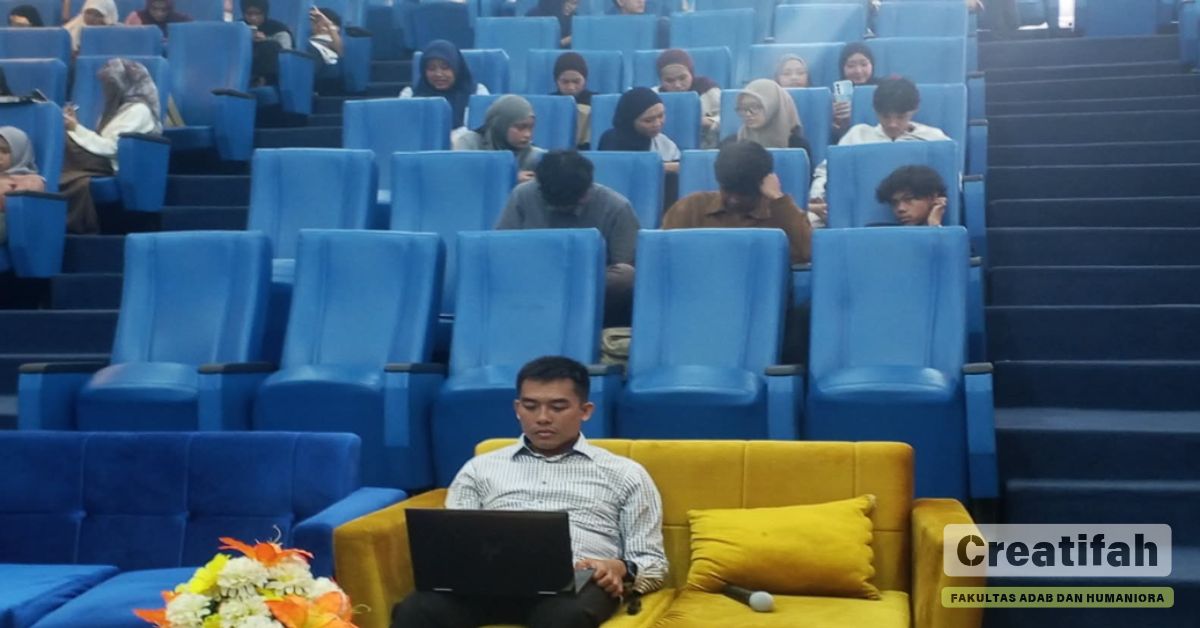
CIPUTAT, FAH ONLINE NEWS — A different atmosphere was evident during the Islamic History and Civilization (SPI) lecture at the Faculty of Adab and Humanities, UIN Syarif Hidayatullah Jakarta, on Tuesday (November 3, 2026). Held in the Abdul Ghani Theater on the fifth floor, two classes were combined for a joint lecture in the History of Medieval Islam course.
The lecture was taught by Muhammad Firman Faturahman, M.Hum., and Prof. Amelia Fauziah, M.A., Ph.D. Unlike conventional classroom sessions, this lecture placed students at the center of the learning process by requiring them to independently present their assignments in front of the class.
Throughout the presentations, Mr. Firman listened to the students from the front row while monitoring the flow of their arguments on his laptop. Meanwhile, students filling the theater seats appeared enthusiastic, attentively following the presentations and actively participating in discussions and question-and-answer sessions.
This innovative teaching method was introduced to create a more dynamic academic atmosphere. In addition to developing students' courage and self-confidence in expressing their ideas before an audience, the two-way interactive discussions enabled them to develop a more comprehensive and contextual understanding of medieval Islamic history.
Learning Objectives and the Lecturer's Perspective
In an interview after the lecture, Muhammad Firman Faturahman, M.Hum., explained the considerations behind implementing the individual assignment and presentation method. According to him, the idea emerged from reflecting on his own academic experiences, both during his studies and throughout his teaching career.
He emphasized the importance of independent learning, ensuring that every student takes full responsibility for their own learning process.
"I deliberately chose not to use a group-based format. Based on my previous experience, group assignments are often ineffective because the workload tends to fall on only a few students. By requiring each student to prepare presentation materials and deliver their presentations individually, they are expected to take full responsibility for their assignments without relying on others. The classroom should serve as a space where students can develop the courage to speak and defend their arguments before entering the professional world," Mr. Firman explained.
Furthermore, Mr. Firman emphasized the importance of mastering academic literature and developing critical analytical skills for aspiring historians. He reminded students not to rely solely on artificial intelligence (AI) technology but to carefully assess the validity and reliability of the primary sources they use.
"As aspiring historians, the ability to verify primary sources is fundamental. Students must genuinely understand the substance of the references listed in their bibliographies so that their arguments carry strong academic weight when presented in external forums. In this third semester, I deliberately challenge them through rigorous training so that every shortcoming can be evaluated. Hopefully, by the time they enter their fourth, fifth, and subsequent semesters, their academic capabilities and readiness will have developed significantly," he stated.
Discussion Dynamics and Student Responses
The implementation of individual presentations in the theater received positive responses from participants in the joint lecture. Although some initially felt challenged and rather nervous, most students considered this format effective in encouraging creativity and deeper engagement with the subject matter.
One of the students participating in the lecture explained that individual presentations required every student to thoroughly master their assigned topics by consulting various academic references.
"At first, I felt quite nervous because I had to present alone on the theater stage in front of two combined classes and the lecturers. However, this method actually prevents us from 'hiding' behind our group members. We have no choice but to read books, analyze academic journals, and master our own presentation slides. The question-and-answer sessions also become more engaging and challenging," one SPI student remarked.
The question-and-answer session unfolded dynamically as students seated in the theater's tiered seating area took turns presenting arguments, seeking clarification, and raising critical questions about the topics in Medieval Islamic History. The lecturers acted as facilitators, clarifying misunderstandings and reinforcing essential concepts.
Pedagogical Implications and Strengthening Academic Quality
The use of the Abdul Ghani Theater on the fifth floor of the Faculty of Adab and Humanities as a venue for the joint lecture created a learning atmosphere resembling an academic conference. This approach was designed as part of the strategy to develop the competencies of graduates from the Islamic History and Civilization Study Program, preparing them to compete in broader professional and academic environments.
The integration of literature synthesis, effective presentation media, public speaking skills, and the critical examination of logical arguments served as key benchmarks in shaping young historians who are critical, independent, and accountable.
Through regular evaluations during each session, the lecturers hope that the academic standards of students in the Islamic History and Civilization Study Program at UIN Syarif Hidayatullah Jakarta will continue to improve, enabling them to produce high-quality historiographical