
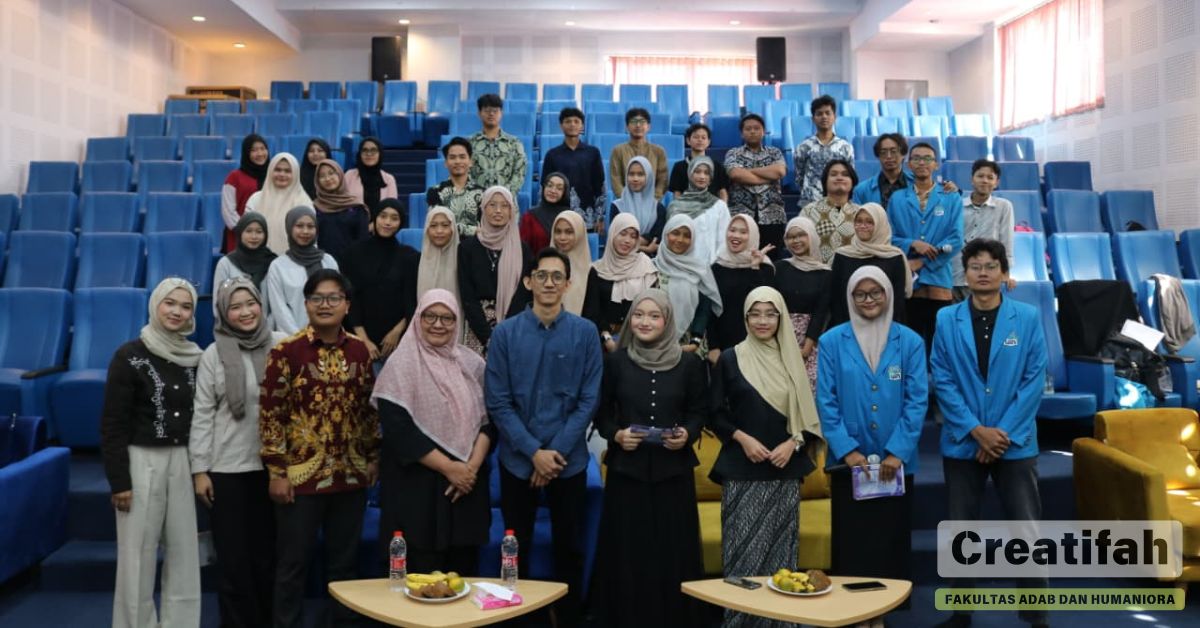
Enhancing Student Competence in the Digital Era, LO Creatifah and DEMA FAH UIN Jakarta Hold Fundamental Graphic Design Workshop
South Tangerang, FAH Online News — In order to enhance students’ readiness to face the rapidly evolving dynamics of the digital workforce, the Autonomous Institution (LO) Creatifah, in collaboration with the Student Executive Board (DEMA) of the Faculty of Adab and Humanities (FAH), Syarif Hidayatullah State Islamic University (UIN) Jakarta, organized an educational collaborative seminar focusing on mastering the fundamentals of graphic design. This joint event was initiated as an active response to the high demand of modern industries for effective and relevant visual communication skills. By presenting experienced practitioners in the field, the event successfully attracted strong enthusiasm from students committed to expanding their practical competencies beyond the formal academic curriculum.
This synergy between student organizations began with a series of opening remarks emphasizing a shared commitment to providing an applied learning space for students at the Bustami Abdul Ghani Theater Hall. The Head of the Committee, Zaskia Syahda Hafizha Kurniawan, in her speech expressed gratitude for the gathering of all attendees in good health. She stated that in today’s fast-paced modern era, people are constantly bombarded with thousands of pieces of information every day. Therefore, she emphasized the importance of design as a form of visual communication that functions as a universal language, not merely an aesthetic element. This aligns with the event’s tagline, “One Work, a Million Meanings.” Through this Design Up! 2026 seminar, she invited all participants to learn how to create well-developed visual works through the proper use of color selection, typography, and layout so that they can convey complex messages, touch emotions, and deliver millions of meanings to audiences within seconds without the need for words.
After the closing of the warm opening remarks by the Head of the Committee, who also officially opened the seminar, the Head of Communication and Information of DEMA, Radja Fatahillah, delivered his opening remarks expressing his hope that the entire event would provide real benefits and serve as a valuable stimulus for participants to continue exploring their potential in the field of technology and information.
Full support for this positive activity was also expressed by the faculty leadership, who recognize the importance of aligning students’ skills with labor market needs. The Vice Dean I for Academic Affairs of FAH UIN Syarif Hidayatullah Jakarta, Dr. Ida Farida, M.L.I.S., presented a strategic overview of how mastering practical competencies like these can broaden students’ perspectives and increase the value and attractiveness of their CVs when applying for jobs in the future. She also added that this seminar would be an important consideration for the faculty board in mapping future student skill development programs. On the same occasion, Dr. Ida Farida appreciated Generation Z for their rapid response to digital information flow. In closing, she delivered a profound message encouraging students to make the most of their eight semesters of study to master as many competencies offered by the faculty as possible, so that upon graduation they are confident and fully prepared to enter any industry.
In the main presentation session, the seminar featured Lanna Andriana, S.IP., a freelance graphic designer and professional logo branding specialist who is also an alumna of the Library Science program at UIN Syarif Hidayatullah Jakarta. With more than ten years of professional experience in design and three years in social media management, Lanna has successfully handled various visual communication projects across different sectors, including culinary, fashion, jewelry, and public institutional identity.
At the beginning of her presentation, Lanna invited participants to understand the most fundamental essence of graphic design, which she defined as the process of combining elements related to imagery, art, and communication. Graphic design is not merely a visual aesthetic activity but a structured method of integrating various components so that each piece of information carries specific meaning, enabling the public to quickly and accurately understand messages through engaging visual presentation.
Furthermore, Lanna explained the four main pillars of design fundamentals that are essential for producing clean, balanced, and professional work. These four key principles include contrast to create visual emphasis, visual hierarchy to guide audience reading flow, alignment to ensure order and structure, and white space to provide balance and focus in design. She explained that consistent application of these principles significantly improves the quality and neatness of design work. Mastery of these fundamentals also opens up wide opportunities in the creative industry, including employment in reputable companies, attracting clients for freelance projects, expanding professional networks, and building strong credibility as an expert in the field.
The seminar became increasingly dynamic and interactive during the Q&A session, when one participant raised a critical question regarding the rapid development of Artificial Intelligence (AI), which is now far more advanced than it was a year or two ago. The participant expressed concerns about companies increasingly using AI to produce visual assets and questioned whether human designers would still be needed in the future or eventually be replaced by automation.
In response, Lanna provided an optimistic and reassuring perspective. She explained that concerns about AI dominance have been widely discussed since the COVID-19 pandemic, but human creativity cannot be fully replaced. She emphasized that individuals who do not understand basic design principles and prompt engineering will still struggle to produce high-quality visual work. In fact, the growing skill today is the ability to craft precise prompts to direct AI systems effectively.
From a technical and personal standpoint, Lanna sees AI not as a threat but as a strategic partner that can enhance designers’ efficiency. System limitations such as usage quotas and the need for repeated generations to achieve desired results demonstrate that human intuition, taste, and final decision-making still hold full control in producing meaningful visual communication work. The collaborative seminar concluded with a shared commitment from the faculty, LO Creatifah, and DEMA FAH to continue providing adaptive skill development spaces for a brighter student future.
Authors: Nadhira Sonja Isinbayeva and Afwa Qurrota Aini