Accreditation Certificate of the Bachelor’s Program in Translation (Excellent)

Bachelor’s Program in Translation

To become a leading study program grounded in scholarship, Islamic values, and Indonesian identity.

  1. To provide education and teaching in the fields of linguistics and translation.
  2. To conduct research in the fields of linguistics and translation.
  3. To carry out community service in the fields of linguistics and translation.


Graduate Learning Outcomes

  1. Able to apply logical, critical, systematic, and innovative thinking in the development or implementation of science and technology while considering and applying humanities values relevant to the field of translation.
  2. Able to demonstrate independent, high-quality, and measurable performance.
  3. Able to examine the implications of the development or implementation of science and technology that considers and applies humanities values in accordance with their expertise, based on scientific principles, procedures, and ethics, in order to produce solutions, ideas, designs, or art criticism; prepare a scientific description of the study results in the form of a thesis or final project report; and upload it to the university website.
  4. Prepare a scientific description of the study results in the form of a thesis or final project report and upload it to the university website.
  5. Able to make appropriate decisions in solving problems within their field of expertise based on information and data analysis.
  6. Able to maintain and develop working networks with supervisors, colleagues, and peers both inside and outside their institution.
  7. Able to take responsibility for the achievement of group work outcomes and to supervise and evaluate the completion of tasks assigned to workers under their responsibility.
  8. Able to conduct self-evaluation of the work group under their responsibility and manage learning independently.
  9. Able to document, store, secure, and retrieve data to ensure validity and prevent plagiarism.

  1. Master communicative Arabic language skills, including listening, speaking, reading, and writing.
  2. Able to translate Arabic into Indonesian and vice versa while upholding the values of nationalism and national culture.
  3. Able to manage secretarial work, correspondence, administrative tasks, and business services using Arabic as the medium of communication with honesty, responsibility, intelligence, skill, and courtesy.
  4. Able to listen to and read online and offline Arabic journalistic products and present news orally and in writing in Arabic.
  5. Able to apply translation-related information and communication technology (ICT) tools to improve graduates’ competence and professionalism.
  6. Able to apply corpus-linguistics translation software in research and linguistic development in the field of Arabic translation with honesty and responsibility.
  7. Able to create translation products that can be used as learning references, teaching materials, and translation products according to stakeholders’ needs.
  8. Able to prepare translation evaluations or translation criticism covering three aspects: revision, evaluation, and translation review.

  1. Be devoted to God Almighty and demonstrate Islamic attitudes.
  2. Uphold humanitarian values in carrying out duties based on religion, morals, and ethics.
  3. Contribute to improving the quality of life in society, the nation, and the state, as well as the advancement of civilization based on Pancasila.
  4. Act as citizens who are proud of and love their homeland, possess nationalism, and have a sense of responsibility toward the state and nation.
  5. Respect diversity in culture, views, religion, and belief, as well as the opinions or original findings of others.
  6. Cooperate with others and demonstrate social sensitivity and concern for society and the environment.
  7. Obey the law and uphold discipline in social and national life.
  8. Internalize academic values, norms, and ethics.
  9. Demonstrate a responsible attitude toward work in their field of expertise independently.
  10. Internalize the spirit of independence, resilience, and entrepreneurship.

  1. Possess knowledge of language studies, particularly Arabic as the object of study.
  2. Master the concepts of the Arabic sound and writing systems.
  3. Master the concepts of Arabic grammar, including Arabic morphology and syntax.
  4. Master the concepts of meaning in Arabic, including Arabic semantics and pragmatics.
  5. Master the mental processes involved in Arabic language production, reception, and translation.
  6. Master the use of Arabic in social life.
  7. Possess insight into Arab art, culture, and regions.
  8. Possess insight into Arabic linguistics.
  9. Master the concepts of translating Arabic into Indonesian and Indonesian into Arabic.
  10. Possess insight into Arabic ICT in relation to translation.
  11. Master the concepts of research in the field of Arabic language studies.

Courses by Semester

Semester 8
No. Course Credits
1 Community Service Program (KKN) 4
2 Thesis 6

2025 Curriculum

Semester 1
No. Course Credits
1 Pancasila Education 3
2 Civic Education 3
3 Indonesian Language 3
4 English 3
5 Qira’at and Worship Practicum 2
6 Nahw (Arabic Syntax) 3
7 Sarf (Arabic Morphology) 3
8 Arabic ICT 2
Semester 2
No. Course Credits
1 Sarf for Translation 3
2 Nahw for Translation 3
3 Fundamentals of Listening and Speaking Arabic 3
4 Fundamentals of Reading Arabic Texts 3
5 Fundamentals of Intralingual Arabic Text Reading 3
6 Arabic Text Reading Skills 3
7 Theories and Issues in Arabic–Indonesian–English–Mandarin Translation 4
Semester 3
No. Course Credits
1 Islamic Studies 4
2 Arabic Listening and Speaking Skills 3
3 Fundamentals of Arabic Writing 3
4 Introduction to Arabic Linguistics 3
5 Translation of Classical Arabic Texts 3
6 Translation of Modern Arabic Texts 3
7 Methods of Academic Writing 2
Semester 4
No. Course Credits
1 Islam and Science 3
2 Indonesian Muslim Society 3
3 Arabic Writing Skills 3
4 Translation ICT 2
5 Arabic Phonetics and Phonology 3
6 Arabic Lexicography 3
7 Balaghah 3
Semester 5
No. Course Credits
1 Fundamentals of Arabic Correspondence 3
2 Arabic Semantics and Pragmatics 3
3 Terminology 3
4 Translation Publication 3
5 Methods of Academic Writing 3
6 Research Methods 3
7 Translation Research Methods 3
8 MBKM Program 4
Semester 6
No. Course Credits
1 Editing of Translated Manuscripts 3
2 Translation of Economic and Business Texts 3
3 Translation of Technology and Information Texts 3
4 Translation of Administrative and Academic Documents 2
5 Translation of Tourism and Product Texts 3
6 Conference Interpreting 3
7 Community Service Program 4
Semester 7
No. Course Credits
1 Translation Criticism 3
2 Translation of Literary Texts 3
3 Translation of Mass Media Texts 3
4 State Diplomacy Interpreting 3
5 Digital Marketing in Translation 3
6 Translation of Political, Legal, and Human Rights Texts 3
7 Thesis Proposal 2
Semester 8
No. Course Credits
1 Undergraduate Thesis 6
Academic Achievements
  1. Siti Nazmi Muqurrobi
    Completed the Memorization of the Qur’an, Juz 1–30
  2. Nafisah Zahro
    First Place in a Scientific Writing Competition
Non-Academic Achievements
  1. Alfina Ika Arianti
    Selected as Best Writer in the “Festival Menulis Analogi”
  2. Nandhita Durrotun Nafisah
    Second Place in Gema Muslimah Writing Competition
  3. Herawati Irawan
    Certificate of Second Place in the National Poetry Competition
  4. Tahta Ulani
    First Place, Team Knot-Tying Competition at Jamnas
Admission Criteria

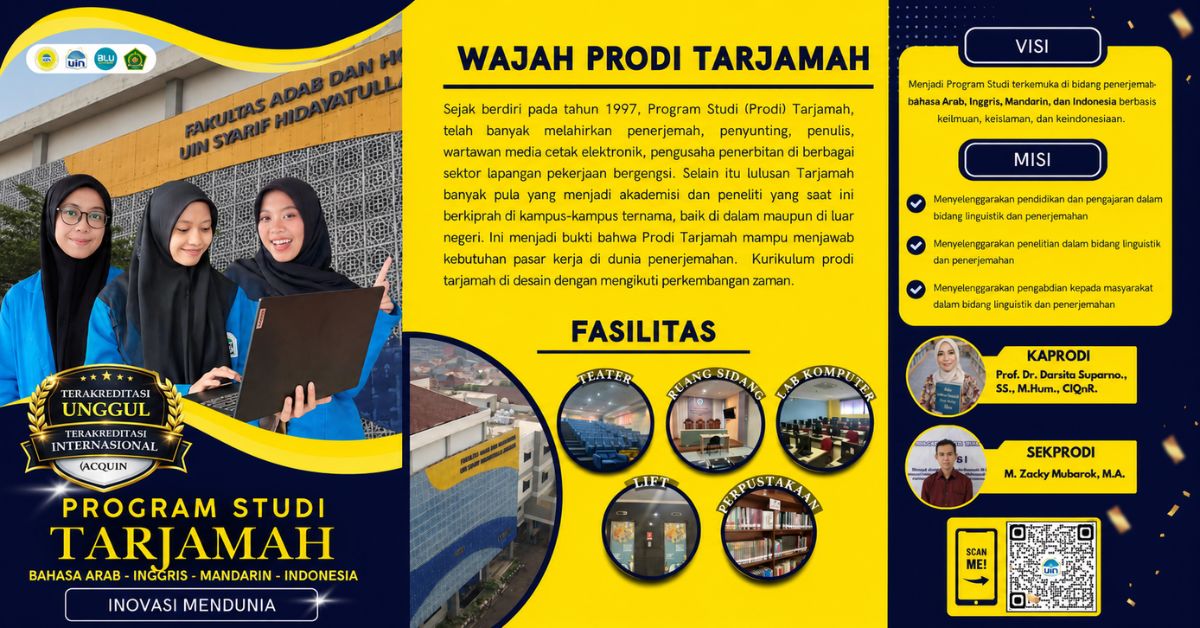
Translation Flyer 1

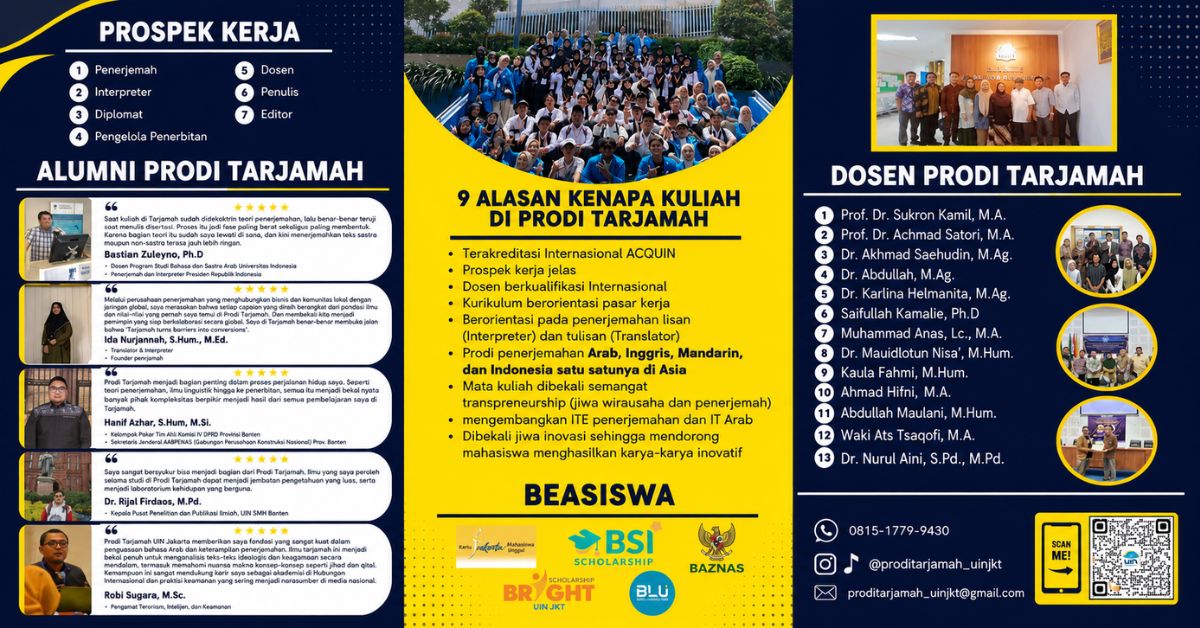
Translation Flyer 2


Learning Outcomes
Your content here
Teaching
TRA students are required to complete 49 courses, consisting of compulsory and elective courses, or the equivalent of 144 credits (216 ECTS). Courses are delivered in two languages, namely Arabic and Indonesian. Since 2019, TRA has invited two guest lecturers from Al-Azhar University.
The teaching process is generally conducted through lectures. However, several courses are delivered in seminar format. Final assignments may take the form of research papers, such as in Contemporary Text Translation and Modern Text Translation courses. Some courses also include practical sessions using IT media or specific applications, such as the Translation Information and Communication Technology course. (TRA Semester Learning Plan).
Project-based learning: Several courses in TRA use project-based learning to produce videos and upload them to YouTube channels. For example, students may create tutorial videos on CAT tools for Arabic–Indonesian translation or tutorials on how to use AI for translation. In addition, some translation courses culminate in the development of an encyclopedia or an Arabic–Indonesian dictionary.
Case-study learning: Case-study learning is commonly applied in translation courses. Students may translate texts on topics such as law and human rights, then critically analyze and evaluate them from the perspective of Indonesian law and human rights. In addition, some courses critically analyze conference interpreting to understand and assess the use of spoken Arabic in conference settings.
  1. Classroom enrichment learning activities:
    TRA implements various classroom learning activities, such as reading lecture materials, discussions, expert seminar presentations, watching videos from YouTube and other social media platforms, and analyzing auto-captions for class discussion. In addition, as discussion material, some courses present pictographs from various regions to analyze the meaning of these images in their countries of origin and compare them with perspectives from
    Indonesia.
  2. Information Literacy Workshop
    An information literacy workshop is held for new students, including TRA students. In this workshop, students are taught strategies for finding information sources in the fields of Arabic language and literature, how to use reference managers for academic writing, and how to avoid plagiarism.
Assessment

Assessment components in each course consist of formative assessment, midterm examination, and final examination. The assessment components are presented in several ratio options, for example, 30% formative assessment, 30% midterm examination, and 40% final examination. The formative score consists of student attendance, structured assignments, individual assignments, and attitude. Midterm and final examinations are based on written/oral examinations and projects.
For students’ language proficiency, TRA requires a TOAFL score of 400 and a TOEFL score of 450. TRA also encourages students to publish their academic articles in reputable journals. Other options include providing Indonesian subtitles for Arabic-language films, both text and audio, and translating classical books by Indonesian scholars, websites, and online media portals into Arabic. (Academic Guidelines)

Screenshot 2024-12-09 161850
 
The bar chart in Figure 2.3.9 shows the grade distribution for the TRA (Translation) study program in the first and second periods. In the first period, the majority of students earned an “A” grade (64.5%), followed by a “B” grade at 29%, with very few lower grades. In the second period, a similar trend is observed, with “A” grades slightly decreasing to 63.2% and “B” grades increasing to 32.3%. The proportion of “C,” “D,” and “E” grades remained very low in both periods, indicating strong overall academic performance among students. The findings show consistency in high-grade achievement across periods, with a slight shift between “A” and “B” grades.
The achievement of Program Learning Outcomes (PLOs) is evaluated periodically through PLO evaluation. The results of the PLO evaluation can be seen in the figure below.
Screenshot 2024-12-09 162026
At the end of each academic semester, the pedagogical approach in TRA is assessed by students using EDOM. TRA EDOM results from 2020 to 2022 show that the personality aspect of lecturers’ teaching activities consistently achieved outstanding results. Therefore, lecturers in TRA are generally highly respected and appreciated, with evidence indicating the creation of a supportive and conducive learning environment. (Semester Learning Evaluation).
Screenshot 2024-12-09 162237
TRA EDOM results from the 2020–2022 academic years illustrate students’ evaluations of their lecturers in four categories: Pedagogy, Professionalism, Personality, and Social Aspects. During this period, the Professionalism category consistently received the highest scores, starting at 3.50 in the first semester of 2020/2021, then showing a slight decrease in the following period while maintaining a strong evaluation score of 3.30 in the first semester of 2021/2022.
Personality ratings remained stable, starting and ending at 3.41, reflecting consistent student appreciation in this area. Social ratings were the lowest among the categories, starting at 3.10 and showing slight fluctuation before eventually rising to 3.30 in the most recent recorded period. The Pedagogy category showed some variability, beginning at 3.39, decreasing briefly, and then ending at 3.30, indicating modest but consistent student appreciation throughout the period. Overall, the EDOM results indicate positive perceptions across all evaluated aspects, with particular emphasis on Professionalism and Personality. Based on EDOM data from the last two years, the evaluation results of the TRA teaching and learning process show that the professional aspect was the highest, with an average score of 3.58.
Screenshot 2024-12-09 162431
Figure 2.3.12 presents the average EDOM score (Student Evaluation of Lecturers) for the TRA program from the 2020/2021 to 2021/2022 academic years. The initial score in the first semester of 2020/2021 was 3.60, which decreased to 3.30 in the following semester. This average of 3.30 remained stable in the first semester of 2021/2022 before returning to 3.60 in the second semester of that academic year. These results show a fluctuating pattern, with high satisfaction in the first two periods followed by a slight decrease in the subsequent period. This pattern reflects an overall level of consistency in student evaluations with some improvement in later periods. Based on the average teaching and learning process evaluation results from EDOM data over the last two years, the TRA EDOM score remains above 3 and continues to improve.

 
Graduation Rate and Learning Opportunities
Your content here
Graduate Employment Information
Your content here

Study Program Documents

List of academic and supporting documents for the Translation Study Program.

No. Document Name Year Description Link
1 BAN-PT Accreditation Certificate 2024 - 2026 Accreditation of the Bachelor’s Program in Translation with an Excellent rating View
2 BAN-PT Accreditation Certificate 2021 - 2026 Accreditation of the Bachelor’s Program in Translation with an A rating View
3 BAN-PT Accreditation Certificate 2016 - 2021 Accreditation of the Bachelor’s Program in Translation with an A rating View
4 BAN-PT Accreditation Certificate 2011 - 2016 Accreditation of the Bachelor’s Program in Translation with an A rating View
5 BAN-PT Accreditation Certificate 2006 - 2011 Accreditation of the Bachelor’s Program in Translation with an A rating View
6 Study Program Establishment Decree 1999 Decree on the Establishment of the Translation Study Program View
7 ACQUIN Certificate 2025 - 2031 ACQUIN Certificate for the Bachelor’s Program in Translation View
8 2025 Curriculum 2025 2025 Curriculum of the Translation Study Program View
9 Internal Quality Audit (AMI) Report 2023 - 2025 Internal Quality Audit (AMI) Report. View
10 Management Review Meeting (RTM) Report 2023 - 2025 Management Review Meeting (RTM) Report. View
11 Rector’s Decree 2022 - 2025 Faculty Quality Assurance Coordinator and Study Program Quality Assurance Unit. View
12 PLO Spider Web 2022 - 2025 PLO Spider Web. View
13 PLO Assessment 2022 - 2025 PLO Assessment. View
14 Dean’s Decree 2022 - 2024 Implementation of Curriculum Review. View
15 LED IAPS 5.1 2025 LED IAPS 5.1. View
16 LKPS IAPS 5.1 2025 LKPS IAPS 5.1. View
17 Conversion Supplement Instrument (ISK) 2024 Conversion Supplement Instrument (ISK) Report. View
18 RPS Alignment Evaluation Meeting 2024 - 2026 RPS Alignment Evaluation Meeting. View
19 MBKM Report 2023 - 2024 MBKM Report. View